Bottom Line Up Front
Wildland fire shelters that do not conform to U.S. Forest Service specification 5100-606 are circulating on the open market and may fail to protect firefighters during a burnover or entrapment — potentially causing serious injury or death. The National Wildfire Coordinating Group (NWCG) issued Safety Warning 23-01 on this specific threat, directing all wildland firefighters to inspect any shelter acquired outside of federal procurement channels and to pull non-compliant gear from the fireline immediately.
What the NWCG Warning Actually Says
According to the NWCG's Safety Warning 23-01, fire shelters found for sale on the open market have not been manufactured to specification 5100-606 — the binding federal standard that governs every material, component, and design element of a compliant shelter. The warning states that use of a non-specification fire shelter may result in serious injury or death during an entrapment or burnover. Bill Yohn, Acting Chair of the NWCG Equipment Technology Committee, is attributed in the warning with that direct caution.
The NWCG's announcement identifies two distinct failure modes that make non-specification shelters dangerous. First, materials in uncertified shelters are not tested for toxicity, meaning they may release hazardous substances when exposed to the extreme heat of a wildfire. Second, the physical construction of non-specification shelters may prevent proper deployment — a shelter that does not open and seal correctly in seconds offers no meaningful protection.
The warning specifies that fire shelters procured through FedMall — the federal government's online procurement platform — meet specification 5100-606. Shelters obtained through any other channel require immediate verification before use.
Why Specification 5100-606 Exists
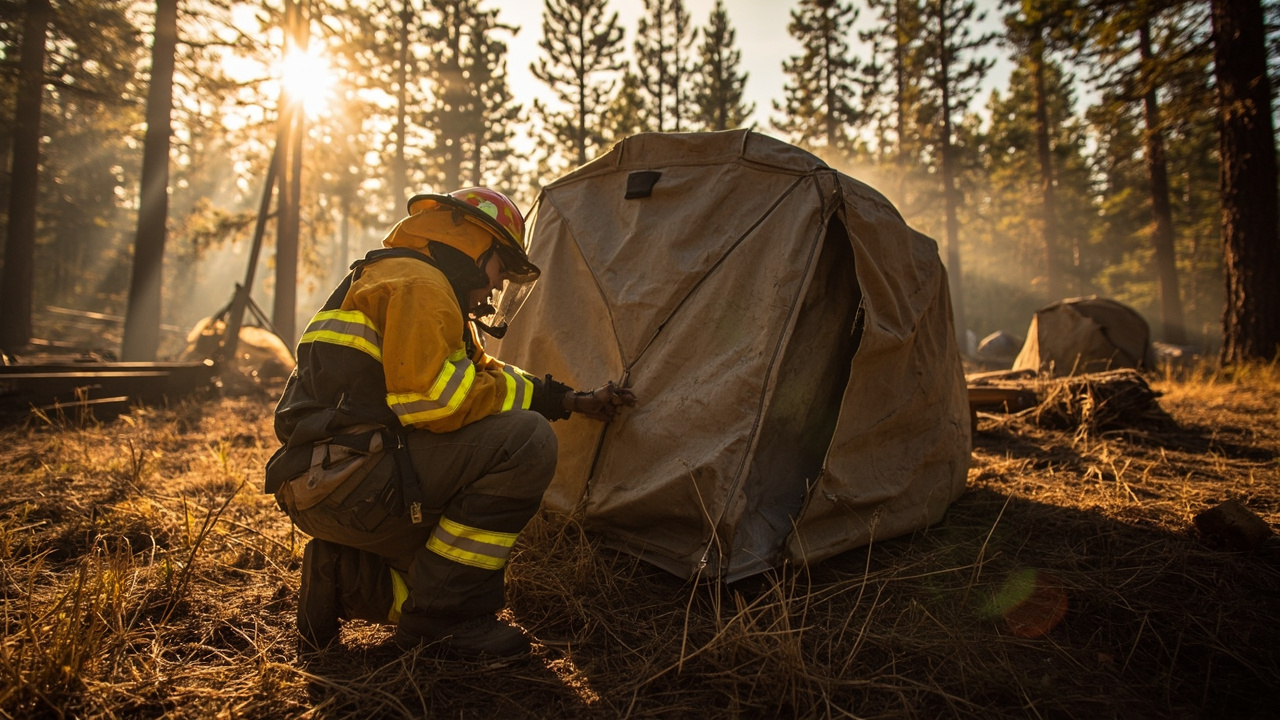
The U.S. Forest Service developed specification 5100-606 after decades of wildland firefighter fatalities in burnover events. A compliant shelter is a layered, aluminized structure engineered to reflect radiant heat and trap breathable air close to the ground. Every material in the assembly — foil layers, adhesives, and the carrying pouch — must pass defined tests for heat resistance, structural integrity, and off-gassing.
Non-specification shelters may use visually similar foil materials that perform far below these benchmarks. Without independent lab verification, there is no way for a firefighter to distinguish a compliant shelter from a counterfeit by visual inspection alone — which is precisely why the NWCG's Safety Warning 23-01 mandates a structured inspection protocol rather than a simple look-and-feel check.
The U.S. Fire Administration's coverage of this warning reinforces that wildland fire shelters are a last-resort tool, not a primary escape strategy, and that any degradation in shelter performance removes the final margin of safety a trapped firefighter possesses.
How to Inspect Your Shelter Right Now
The NWCG's guidance, as covered by the U.S. Fire Administration's wildland fire shelter safety warning, identifies three immediate steps firefighters and crew supervisors must take.
Step 1 — Verify the Procurement Source
Confirm that every shelter currently in service was purchased through FedMall or an authorized federal supply channel. Shelters obtained through commercial online marketplaces, private resellers, or non-federal surplus sources cannot be assumed compliant and must be treated as suspect until proven otherwise.
Step 2 — Check for Specification Labeling
A compliant shelter will carry labeling that references U.S. Forest Service specification 5100-606. Shelters lacking this labeling, or bearing only generic fire-proximity or emergency-blanket branding, are not specification shelters and must be removed from service.
Step 3 — Assess Physical Condition
Even a compliant shelter can be compromised by improper storage or shipping damage. Inspect the carrying pouch and foil assembly for punctures, delamination, or moisture intrusion. Any shelter showing physical damage should be pulled from the fireline regardless of its specification status.
The Counterfeit and Gray-Market Problem
The broader issue behind Safety Warning 23-01 is not a single bad-actor manufacturer but a structural vulnerability in how emergency gear reaches end users. Wildland fire shelters are specialized, federally managed equipment — yet their visual similarity to commercial emergency blankets makes them susceptible to gray-market substitution. When shelters are sourced outside the federal supply chain, there is no quality assurance checkpoint to catch non-compliant products before they reach a firefighter's pack.
According to the NWCG Equipment Technology Committee's published warning, the committee identified shelters being sold on the open market that do not adhere to the critical material and design specifications required for safe deployment. The committee's recommendation is unambiguous: if the source is unknown or non-federal, treat the shelter as non-specification.
For preparedness professionals and crew supervisors, this warning has a direct operational implication. Pre-season gear audits should now include explicit procurement-source verification for every shelter in inventory — not just a pass-fail visual check.
Recommended Actions for Wildland Firefighters and Supervisors
The NWCG's Safety Warning 23-01 and the U.S. Fire Administration's associated guidance together point to the following actions:
- Remove suspect shelters immediately. Any shelter not traceable to FedMall or a verified federal channel should come off the fireline now, not at the end of the season.
- Source replacements through FedMall. This is the only procurement path that guarantees specification 5100-606 compliance.
- Brief crews on the issue. Individual firefighters may have purchased personal shelters independently; supervisors should ensure the warning reaches everyone on the crew.
- Incorporate shelter inspection into pre-deployment checks. Procurement verification and condition assessment should be standard items on every pre-season and pre-assignment checklist.
- Train regularly on proper deployment. Even a compliant shelter only performs as intended if the firefighter can deploy it correctly under stress. Regular practice drills remain essential.
What This Means for the Broader Preparedness Community
The NWCG's warning is directed at wildland firefighters, but it carries a lesson that extends to anyone who relies on emergency protective gear: the federal supply chain exists for reasons beyond cost and convenience. Specification 5100-606 shelters represent the outcome of incident investigations, materials science research, and regulatory oversight. Substituting a lower-cost, visually similar product for certified gear eliminates that entire safety margin.
For preppers and emergency responders who stock fire-proximity gear outside of occupational firefighting contexts, the warning from the NWCG serves as a reminder to verify that any protective equipment meets the standard it claims — and to be skeptical of products that offer no third-party certification or traceable specification compliance.
The fireline is the harshest possible test environment. A shelter that fails there offers no second chances.
Sources referenced
- Safety Warning 23-01: Non-Specification Fire Shelters — NWCG (https://www.nwcg.gov/announcement/general/safety-warning-23-01-non-specification-fire-shelters)
- Wildland Fire Shelter Safety Warning — U.S. Fire Administration (https://www.usfa.fema.gov/blog/wildland-fire-shelter-safety-warning/)