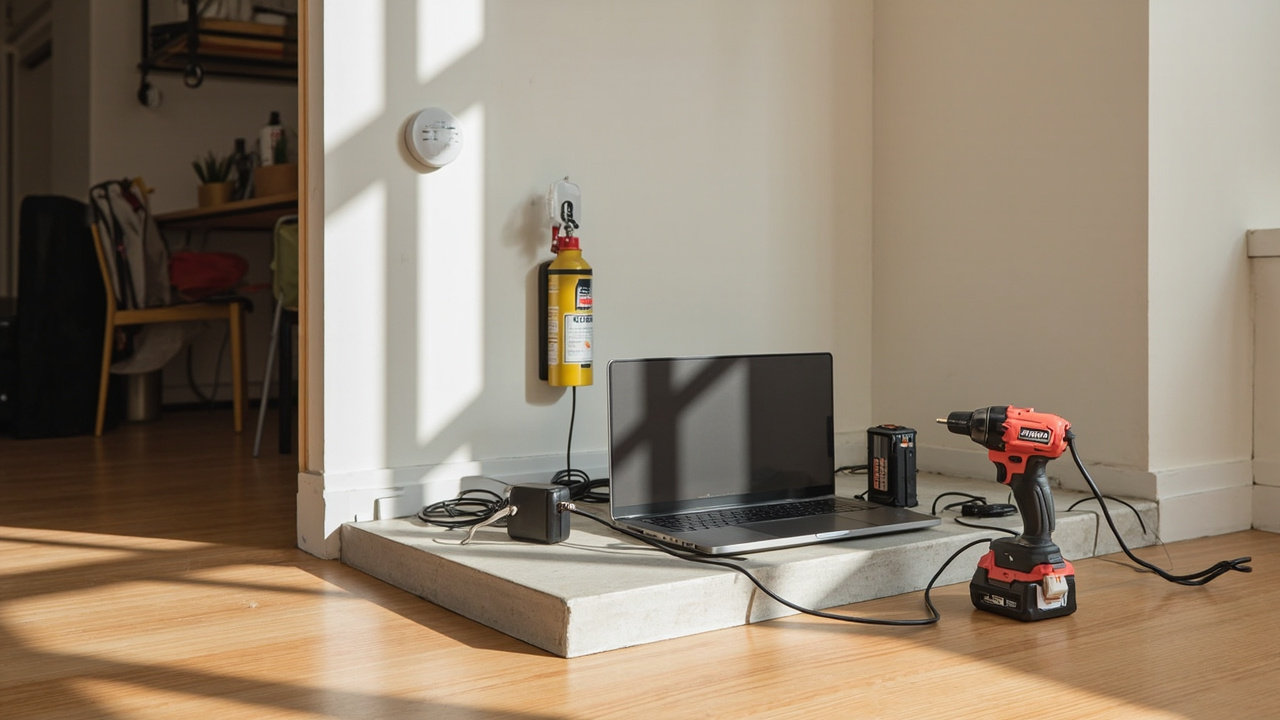
TL;DR: A single laptop left plugged in overnight caused an estimated $2.5 million in fire and smoke damage, showing why home and workplace charging habits need to change now.
County Technical Services, Inc. reported that loss in its Technical Update vol. 30 no. 36 — Managing Lithium-Ion Battery Fire Risks, published September 8, 2026. According to County Technical Services, Inc., the incident began as a recent CAPP claim involving a laptop left charging overnight and ended with major property damage, business interruption, and costly claims. The bulletin stresses that danger is not limited to electric vehicles or large battery systems.
That conclusion matters for preparedness readers because the same cells power laptops, phones, tablets, power tools, e-bikes, and other rechargeable equipment used in counties every day, according to County Technical Services, Inc. Reviews of facility practice published by TJ Nowak Supply on September 7, 2026 add that forklifts, radios, and other operations equipment create the same charging load in warehouses, shops, and fleet areas. Coverage of new industry guidance in Best Magazine on September 8, 2026 notes that business insurer QBE now counts an average of 4.8 lithium battery fires per day attended by UK Fire and Rescue Services.
The $2.5 million overnight charging loss
According to County Technical Services, Inc., the CAPP member fire started when a laptop remained plugged in overnight. The resulting fire and smoke damage was estimated at $2.5 million.
The bulletin presents the case as evidence that one everyday device can cause significant property damage and interrupt operations. For counties, the bulletin says, the outcome also raised property and liability exposure and claim costs for both the county and CAPP.
The lesson for households and small organizations mirrors the county lesson: an unattended bedroom, office, or tool-room charger can become a structure fire. According to County Technical Services, Inc., counties should therefore treat safe charging and storage as essential to preventing property loss, rather than as a convenience issue.
Why thermal runaway is hard to stop
Lithium-ion batteries store a significant amount of energy in a small space, according to County Technical Services, Inc. If a battery is damaged, overheated, improperly charged, or defective, it can enter thermal runaway.
Thermal runaway is a rapid temperature rise that can result in fire or explosion. Once it begins, the reaction can spread from one battery cell to another and can be difficult to control, according to County Technical Services, Inc.
Battery fires can also release flammable and toxic gases. Even after a fire appears to be extinguished, damaged lithium-ion batteries may retain energy and potentially reignite, creating additional risk during cleanup and recovery, according to County Technical Services, Inc.
That reignition risk is why facility guidance emphasizes cooling, separation, and professional response over quick cleanup. According to TJ Nowak Supply, a damaged cell can continue generating heat internally, spread from cell to cell, and reignite after flames appear to be out. A sprinkler system may control the building fire without immediately stopping the internal reaction.
Warning signs a battery may fail
According to County Technical Services, Inc., employees should stop using a device if warning signs appear and follow established procedures for safely isolating and reporting the equipment. The bulletin lists six groups of signals:
Heat, shape, sound, and smell
Excessive heat while charging or in use signals possible failure. Swelling, bulging, or changes in shape are additional signals. Hissing, popping, or unusual noises also belong on the watch list.
Unusual odors can indicate a failing cell. Smoke or vapor is a more urgent signal. Leaking or visible damage completes the county list.
Workplace material from TJ Nowak Supply describes a closely matching set: unusually hot, swollen, cracked, discolored, wet, or damaged housings, plus odors, hissing, popping, smoke, or visible leakage. The company advises workers to stop using or charging that battery, to keep it out of normal storage, and to keep it out of general waste containers.
Best Magazine, reporting on hazardous-material storage specialist Asecos, adds industry context for those symptoms: lithium-ion battery fires can escalate rapidly through thermal runaway and may release flammable and toxic gases, as well as presenting an explosion risk.
Safer charging at home and at work
According to County Technical Services, Inc., simple practices can help counties reduce the risk of lithium-ion battery fires. Employees should know how to safely charge and store devices, recognize warning signs, and respond if a battery overheats, smokes, or shows signs of failure.
Use the right charger and inspect it
Counties should use manufacturer-approved batteries and chargers, according to County Technical Services, Inc. They should inspect batteries and charging equipment for damage and follow manufacturer guidelines for charging and storage.
According to TJ Nowak Supply, teams should use only chargers approved for the specific battery or device because a charger that fits a connection is not necessarily compatible with voltage, controls, or charging requirements. The company advises inspecting chargers, cords, plugs, and battery housings, and removing equipment from service with exposed wiring, cracked insulation, overheating, or loose connections.
Set up a low-fuel charging spot
Counties should keep charging areas clear of combustible materials, according to County Technical Services, Inc. They should avoid leaving devices charging unattended for extended periods, particularly overnight.
Practical layout advice from TJ Nowak Supply calls for charging directly from an appropriate wall outlet where possible, avoiding overloaded power strips and daisy-chained extension cords, and placing chargers on hard, non-combustible surfaces. The same guidance calls for clear separation from cardboard, paper, textiles, flammable liquids, and other combustibles, and for keeping charging equipment out of exits, aisles, and other egress routes.
The company also advises allowing batteries and devices to cool after heavy use before charging, and avoiding unattended or overnight charging unless the equipment and facility controls are specifically designed for it.
Build checks into inspections
Counties should establish procedures for reporting and safely handling damaged batteries and include battery hazards in routine facility inspections, according to County Technical Services, Inc. Regularly reviewing charging areas and employee practices can help identify hazards before they result in a loss, the bulletin says.
According to TJ Nowak Supply, fire protection in this context is a broader program that can include portable fire extinguishers, automatic sprinkler systems, fire alarm and detection systems, special-hazard fire suppression systems, hazard assessments, inspection, testing, repair, tagging, documentation, emergency planning, and employee training. The company recommends a professional fire suppression system inspection alongside safe charging procedures, appropriate storage, early detection, properly selected portable extinguishers, and employee training.
Storage, separation, and damaged-battery quarantine
According to County Technical Services, Inc., counties should stop using batteries that are swollen, damaged, or unusually hot. Clear procedures should also address evacuation and notification of emergency personnel if a battery fire occurs.
Storage guidance from TJ Nowak Supply recommends a cool, dry area away from heaters, direct sunlight, ignition sources, and combustible storage. The company advises preventing loose batteries from contacting coins, keys, tools, or other conductive metal objects, and using original packaging, individual cases, or protective terminal covers where practical.
Separation helps prevent one failure from involving other cells. According to TJ Nowak Supply, facilities should separate new batteries, batteries in active use, batteries awaiting recycling or disposal, and damaged, defective, or recalled batteries. A designated quarantine process is essential so employees know where to place a swollen, dropped, punctured, leaking, or overheated battery and who must be notified.
The company cautions against improvising a quarantine container without reviewing battery type, size, condition, and manufacturer or fire department guidance. It also directs readers to manufacturer instructions and facility emergency and hazardous-material procedures, and notes public-safety resources including NFPA lithium-ion battery resources and U.S. Fire Administration battery safety guidance.
If a battery is smoking or burning, the TJ Nowak Supply guidance is direct: evacuate, close doors if safe, call 911, and wait for the fire department.
What this means before Fire Prevention Week
Fire Prevention Week is scheduled for October 4–10, 2026, according to TJ Nowak Supply, with the theme “Charge into Fire Safety.” The company frames the week as a time to review how lithium-ion batteries are charged, stored, inspected, and removed from service.
That timing aligns with expanded sector guidance reported by Best Magazine on September 8, 2026. According to Best Magazine, Asecos published lithium battery safety guides for settings including aviation, construction, data centres, defence, facilities and manufacturing, golf, greenkeeping, healthcare, logistics, marine, police, railways, and universities. The guides are intended to help organizations assess risks, review operating procedures, and consider measures to protect employees, property, and business continuity.
Asecos commercial director Les Day said operating environments change the practical answer, according to Best Magazine. The expanded series followed demand for earlier defence and healthcare guides, with each guide designed to help fire, health, and safety leads consider lithium battery risks and introduce protective measures.
For counties, County Technical Services, Inc. says the next steps are to establish safe charging practices, educate employees on warning signs, and regularly inspect areas where rechargeable devices are used. Those steps, the bulletin says, can protect facilities, reduce property and liability exposure, and help keep claim costs down for both the county and CAPP. For more information, the bulletin lists CTSI at 303.861.0507 and its office at 9380 Station St. Suite 275, Lone Tree, CO 80124.
Sources referenced
- Technical Update vol. 30 no. 36 - Managing Lithium-Ion Battery Fire Risks - CTSI - County Technical Services, Inc (https://www.ctsi.org/technical-update-vol-30-no-36-managing-lithium-ion-battery-fire-risks/)
- Can Your Fire Suppression System Stop a Lithium-Ion Battery Fire? What Fort Wayne Facilities Need to Know Before Fire Prevention Week – TJ Nowak Supply (https://tjnowak.com/index.php/2026/09/07/can-your-fire-suppression-system-stop-a-lithium-ion-battery-fire-what-fort-wayne-facilities-need-to-know-before-fire-prevention-week/)