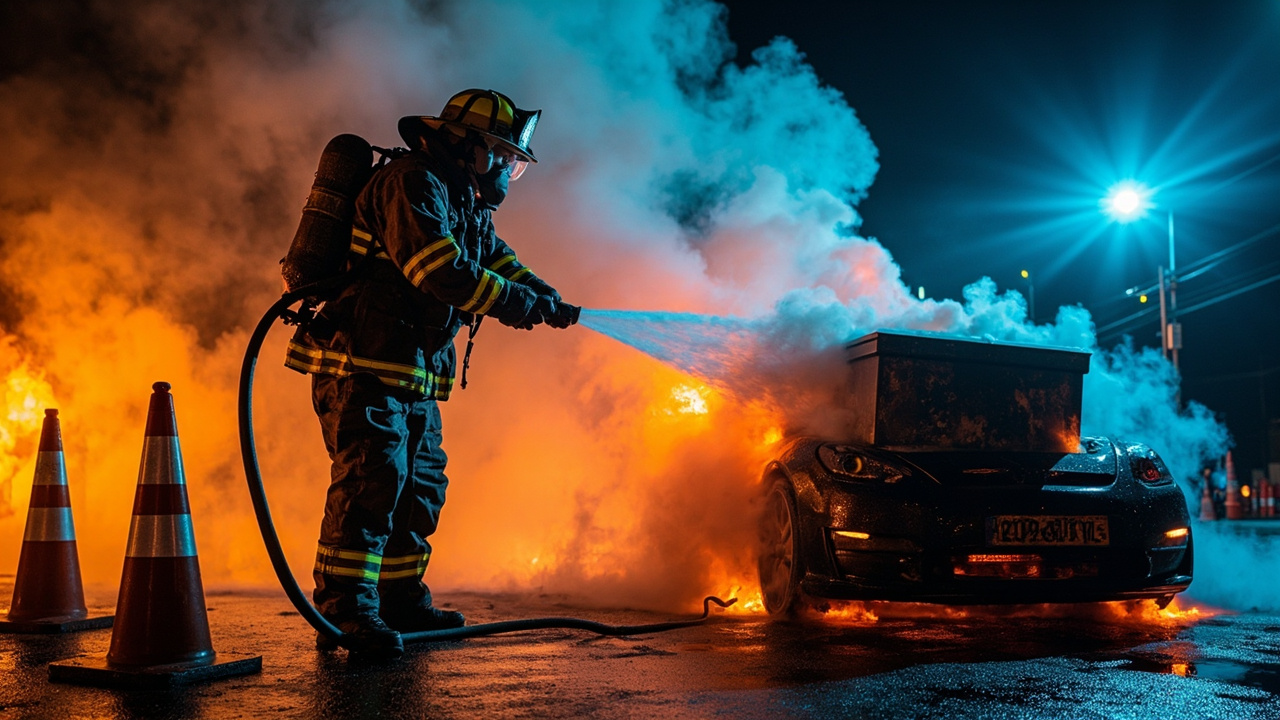
TL;DR: Lithium-ion battery fires can enter thermal runaway, release flammable gases, eject cells, and reignite hours or days later, so federal guidance centers on cooling, isolation, and prolonged monitoring rather than quick extinguishment.
Why Preppers Must Treat Every Lithium-Ion Pack as a Fire Risk
Lithium-ion cells now power toothbrushes, smartphones, construction tools, medical devices, scooters, and cars, according to the U.S. Fire Administration page titled Risks and response strategies for lithium-ion battery fires. That same source notes the cells have changed how homes and cities receive portable power.
For households that stockpile power for outages, the implication is direct. Phones, power-tool packs, e-bikes, scooters, portable power stations, and electric vehicles all share the same underlying failure modes. Understanding those modes before an incident shapes storage, placement, and evacuation planning.
The U.S. Fire Administration page was last reviewed May 1, 2026. Its central warning is that firefighters must recognize distinct challenges and adopt measures built for battery incidents, not conventional fires.
How Thermal Runaway Starts
Overcharging, aging, and damage
Overcharging beyond designed capacity can drive overheating, according to the U.S. Fire Administration. Cycling and aging also matter because repeated charge and discharge gradually degrade cells.
Physical abuse adds another trigger. Mechanical cracking from dropping, mishandling, or collision is listed as a sign of damage that can precede failure.
Volatile electrolytes and uncontrolled heating
The cells hold volatile electrolytes. When high temperature or physical damage affects those electrolytes, flammable gases can be released, according to the U.S. Fire Administration.
Thermal runaway is described as a chain reaction of uncontrolled heating that can produce fire or explosion. Once one cell heats its neighbors, the event can escalate rapidly through a pack.
That progression explains why small devices and large traction packs demand different levels of caution but the same respect for heat buildup.
Warning Signs Your Battery Is Failing
What to watch, listen, and smell for
The U.S. Fire Administration lists bulging, popping or hissing, visible venting of gases, rising temperature, and mechanical cracking as indicators of damage or thermal runaway.
A swelling power-tool pack, a scooter battery that feels unusually hot, or a phone emitting hissing sounds should be treated as a pre-fire condition. Move people away, avoid handling the hot item, and call emergency services rather than attempting to open or puncture the casing.
For preparedness planning, these signs belong on a family briefing card. Store batteries where swelling or venting will be noticed quickly, not buried in closets or sealed bins where heat and gases accumulate unobserved.
Why These Fires Behave Differently
Ejection and secondary ignition
Cells or batteries can be ejected from a pack or casing during an incident, according to the U.S. Fire Administration. Ejected material can spread fire and create cascading events with secondary ignition points.
That behavior makes a garage or workshop especially vulnerable. One failing e-bike pack can ignite nearby fuels, tools, or a second stored pack if spacing and separation were not planned.
Reignition hours or days later
Even after apparent extinguishment, reignition remains possible. The U.S. Fire Administration repeats that warning in two sections, including post-incident transport and placement.
The U.S. Environmental Protection Agency page titled Battery Energy Storage Systems: Main Considerations for Safe Installation and Incident Response states the same persistence at larger scale. Lithium battery fires are extremely difficult to extinguish and may reignite hours or days later.
For a prepper, the lesson is not to bring a fire-damaged device back inside, charge it, or place it in a vehicle trunk unattended. Continued monitoring and thorough post-fire assessment are required to prevent rekindling.
Chemical exposure
Battery fires can release harmful gases that endanger nearby residents and responders, according to the EPA. Firefighters are cautioned about chemical exposure and told to wear proper personal protective equipment.
Home planning should therefore treat smoke from a battery fire as toxic. Evacuate people and pets, keep others upwind, and do not attempt prolonged close-range suppression without respiratory protection.
What Grid-Scale Fires Teach Households
BESS role and community concern
Battery Energy Storage Systems, or BESS, stabilize electrical grids by delivering steady power despite fluctuations from inconsistent renewable generation and other disruptions, according to the EPA. Fires at some installations have raised legitimate safety concerns in host communities.
The EPA lists three unique challenges for communities and first responders: suppression difficulty, emissions that pose health risks, and cleanup and disposal that require specialized procedures.
Improvements in quality and design have reduced failures per gigawatt-hour deployed, the agency notes. Despite that trend since 2020, high-profile fires continue to shape planning.
Gateway Energy Storage Facility, San Diego
On May 15, 2024, the Gateway Energy Storage Facility in San Diego, California, experienced a BESS fire with continued flare-ups for seven days, according to the EPA. The site held about 15,000 nickel manganese cobalt lithium-ion batteries.
After the incident, EPA required the facility to conduct extensive environmental monitoring during battery handling and disposal operations and to submit detailed work plans and progress reports.
The seven-day duration illustrates why water supply, air monitoring, and extended staffing dominate battery response. A household cannot replicate that capacity, which reinforces early evacuation over extended do-it-yourself firefighting.
Moss Landing, Monterey County
On January 16, 2025, a BESS fire broke out at the Moss Landing site in Monterey County, California, resulting in a 24-hour evacuation of about 1,200 residents, according to the EPA. Company personnel and the North County Fire Department kept the blaze contained to one building, although one notable flare-up occurred.
Air-quality monitoring and sampling during and after the fire found no risks to public health. EPA continues to work with other regulators to ensure safe storage, handling, and transportation of undamaged batteries remaining at Moss Landing.
The evacuation of about 1,200 people for 24 hours shows how shelter-in-place or evacuation decisions become central to battery incidents. Households near storage sites, solar farms, or neighbors with large battery banks should include alternate lodging and communications in their plans.
Response Strategies That Actually Work
Protect responders first
The EPA recommends personal protective equipment including self-contained breathing apparatuses to guard against hazardous air emissions. Positioning upwind and uphill is also advised.
The U.S. Fire Administration similarly calls for proper personal protective equipment and caution around chemical exposure. Strategic cooling methods are needed to manage these events effectively.
Establish isolation and safety zones
For large commercial BESS, the EPA advises an isolation zone of at least 330 feet, depending on the site. The U.S. Fire Administration separately calls for establishing safe zones to shield people from potential hazards.
Households can apply the principle at smaller scale. Clear space around charging areas, keep exits accessible, and prevent bystanders from approaching a smoking pack.
Prevent spread rather than chasing flames
Current guidance focuses response on preventing fire spread, according to the EPA. Crews are directed to let the fire burn itself out while using water to protect neighboring batteries and structures.
Research continues into the most effective water-application method to block spread. The agency also calls for minimizing, containing, or redirecting runoff from water use where possible.
For vehicle fires, intensive cooling needs and complex construction complicate access. Construction and design differ across battery-electric and plug-in hybrid makes and models.
Use manufacturer guides and shutdown steps
Firefighters and responders should obtain Emergency Response Guides from original equipment manufacturers to inform rescue and extrication, according to the U.S. Fire Administration. Familiarity with unique designs supports faster, safer action.
Responders are also urged to know emergency shutdown procedures for electric vehicles to isolate the power source and reduce risk. Partnerships with manufacturers and industry specialists, regular training programs, and accurate incident reporting further support safer outcomes.
Reporting matters because detailed investigation and clarification can help develop strategies that reduce future battery-fire incidence. For preppers, retaining incident details, photographs from a safe distance, and device information can assist investigators after the emergency phase ends.
How to Prepare Before an Incident
Design storage and monitoring like a small facility
The EPA recommends compliance with state and local siting, zoning, marking, and permitting rules to confirm site suitability. Design factors include battery chemistry, manufacturing quality assurance, unit design, battery-management-system analytics, system integration, and current industry safety standards.
Remote sensors and monitoring such as infrared, thermal, and fire detection are also recommended. Communication with local responders to develop emergency response plans is listed as a pre-installation step.
Homeowners can mirror that approach. Follow local codes, buy from reputable manufacturers, use the correct charger, avoid overcharging, allow cooling space, install smoke and heat detection near charging and storage areas, and tell household members and local firefighters where large batteries are kept.
Air assessment during a large incident includes modeling for on-site decisions and initial monitoring for hydrogen, carbon monoxide, hydrogen fluoride, hydrogen cyanide, and hydrogen chloride, according to the EPA. As events extend, sampling expands to metals and other combustion byproducts of burning plastics.
That level of monitoring confirms a core preparedness point. Leave extended air sampling, overhaul, cleanup, and disposal of damaged batteries to trained teams with specialized procedures.
Sources referenced
- Battery Energy Storage Systems: Main Considerations for Safe Installation and Incident Response | US EPA (https://www.epa.gov/electronics-batteries-management/battery-energy-storage-systems-main-considerations-safe)