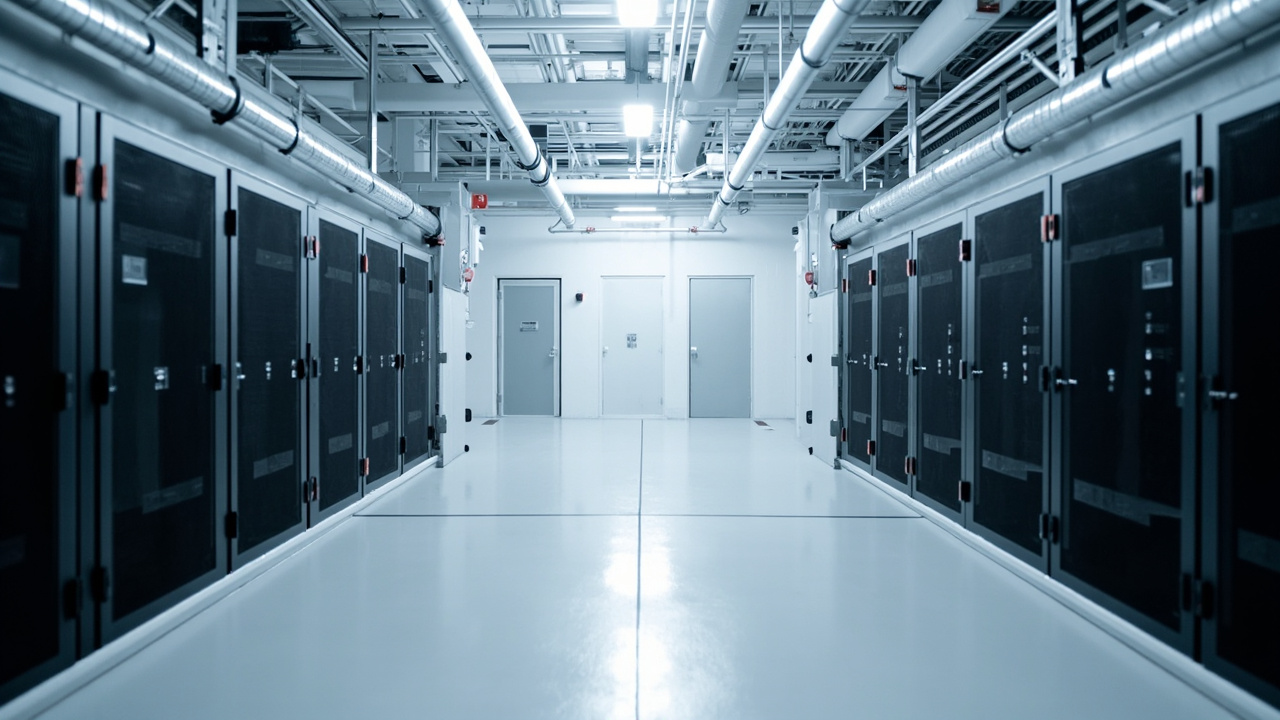
TL;DR: Battery rooms now face separate-room, fire-rated separation rules after a 2025 South Korean government data center fire and a doubling of reported data center fires and power failures since 2024.
Data center battery rooms moved to the center of fire-safety policy by October 12, 2026, as regulators, operators and fire-code writers treated backup-power batteries as a distinct hazard with its own room, walls, monitoring and response plan.
According to UPS Battery Rooms After the NIRS Data Center Fire, South Korea's Ministry of the Interior and Safety (MOIS) said on October 2, 2026, at a briefing marking one year since the National Information Resources Service (NIRS) fire, that it had surveyed all 1,459 public information-system facilities and found 56 where lithium batteries were not separated as the rules require. Those rules were the MOIS notice on integrated standards for information resources of administrative and public institutions, revised in February 2026, whose facility stability standards include separate UPS and battery rooms, battery service-life management and 24-hour monitoring of major equipment.
Why the NIRS fire changed the checklist
According to the same Xylolabs report on the MOIS disaster headquarters briefing, the fire broke out at about 8:15 p.m. on September 26, 2025, while workers were moving the NIRS uninterruptible power supply (UPS) batteries to the basement. It started in one battery whose power had been cut off and was put out at about 6:30 a.m. the next day. The report states that 647 work systems at the Daejeon headquarters were shut down, and that MOIS explained that the fire stopped the precision air conditioning from working properly, so it shut the systems down pre-emptively to keep the servers from overheating.
The one-year briefing set out follow-up actions. According to UPS Battery Rooms After the NIRS Data Center Fire, MOIS in February revised the integrated standards to specify that lithium batteries must be separated from IT equipment and UPS units, and tightened management rules such as battery condition monitoring and compliance with service life. It then surveyed 1,459 public information-system facilities, found 56 that did not separate lithium batteries as required, and recommended immediate improvement in May. MOIS plans to track each institution's action plan until completion and to support a move to private cloud for facilities whose space or building structure rules out direct improvement.
That sequence matters for preparedness planning because it treats separation as a corrective action, not a design preference. Batteries that share air, walls or cable paths with servers or switchgear can expose core systems to heat, gas and suppression water. A separate room with rated boundaries gives crews a compartment to work with and gives operators a chance to isolate one system without shutting a hall.
What the February 2026 Korean standards require
The revised notice is MOIS Notice No. 2026-11, issued and effective on February 11, 2026, according to UPS Battery Rooms After the NIRS Data Center Fire. Article 15 sets the inspection standards for the stability of information-system facilities run by central government bodies and their agencies, local governments and public institutions in Annex 3. Heads of these bodies must work to meet the standards, and a newly built facility must meet them.
Annex 3 sets the required level by the grade of the systems a facility runs. Facilities running grade 1 or 2 systems must meet the high level, grade 3 the medium level, and grade 4 the low level. Each item is marked mandatory or recommended for each level. Annex 3 has 80 items in eight categories. Electrical is the largest category with 26 items, and the UPS and battery rules sit in it.
Under Article 16, heads of institutions must carry out a status survey and self-inspection against Annex 3 every year and register the results in the Information Resource Management system (IRM). The Minister of the Interior and Safety can review the results, order on-site inspections and recommend improvements where the standards are not met. An institution that receives a recommendation must submit an action plan within one month and report the result without delay once the work is done.
The uninterruptible power supply subsection of Annex 3 has six items. UPS configuration is recommended at the low level; the other five items are mandatory at all three levels, according to the same source.
The six items are listed as UPS capacity, UPS configuration, battery capacity, UPS room, battery layout and battery room. UPS capacity calls for at least 130% of the three-month average load. UPS configuration calls for uninterrupted supply despite a partial failure. Battery capacity calls for at least 15 minutes at full 100% load until generator power arrives. The UPS-room item calls for a separate space with fire-rated walls, apart from IT equipment, with separate spaces per load for a 2N UPS. The battery-layout item calls for spacing against fire and explosion by battery type, service-life management, control and monitoring. The battery-room item calls for a separate space with fire-rated walls and fire doors, sealed cable penetrations, and no power lines other than UPS connections.
The same source notes that the battery-room item requires batteries to be installed apart from IT equipment and UPS units. Sealing cable penetrations and keeping power lines other than UPS connections out of the battery room are part of the required safety measures. The battery-layout item adds service-life management, control and monitoring to spacing, and it is mandatory for every facility whatever its grade.
Monitoring, inspection and recovery targets
The management category covers facility monitoring and maintenance. According to UPS Battery Rooms After the NIRS Data Center Fire, a central monitoring room that watches the operation of IT rooms, telecom rooms and electrical rooms and any incidents there is mandatory at all levels. A system and management arrangements that monitor and control the condition of major equipment such as electrical systems are also addressed in that category.
In April MOIS also issued a stability notice for information systems of administrative and public institutions, which grades systems by their impact on daily life rather than by user numbers. About 15,000 public systems were regraded by August. A1 systems are to run a secondary system at another center, with the aim of restoring service within one hour of a disaster. The NIRS Daejeon center is scheduled to close in 2030, according to the same source.
For households, small businesses and community facilities that rely on public portals, the lesson is redundancy on paper before it is needed in practice. Identify which outside services hold critical records, keep alternate access paths, and keep offline copies where the service owner permits it. That is general preparedness practice, not a substitute for the facility-level engineering described in the standards.
Incident data show UPS and battery rooms as leading failure point
According to Number of data center fires and power failures has doubled since 2024, published by Data Centre Dynamics on October 12, 2026, data center fires and power failures rose from eight in 2024 to 20 in 2025 and 19 in 2026, based on the Energy Incident Register, which the article describes as an independently run public register of safety incidents in energy and grid infrastructure.
The same Data Centre Dynamics report states that the Energy Incident Register now tracks data center incidents, based on public reporting, from 2010 to 2026 across 26 countries. Of 93 data center incidents in the period, 47 occurred in 2024 or later. The United States recorded 33 incidents across the 16-year period, and the United Kingdom recorded 14 incidents across the period.
Some 52 of the 93 incidents were fires or thermal events, with 18 classified as major, according to the same report. The most common failures were in uninterruptible power supplies and battery rooms, which represent 22 of the 93 incidents. Backup generators came next, with 15 incidents. In the majority of incidents, 53 of 93, no part was named in reporting.
The same Data Centre Dynamics article notes that DCD reported on several major incidents at data centers in 2026, including a fire at a data center in Gasan-dong, Seoul, South Korea, in September, and a fire in a Tata Communications center in India in June.
For emergency planners, the distribution points to where to ask questions first. When touring, leasing space in, or depending on a facility with on-site UPS storage, ask where batteries sit relative to servers and switchgear, how penetrations are sealed, and how maintenance on live strings is controlled.
Why lithium-ion rooms need a different design
According to Lithium-Ion Battery Fire Protection in Data Centers, updated in October 2026, several of the largest data center fires of recent years started in lithium-ion UPS batteries. The guide states that a cell in thermal runaway makes its own heat and flammable gas, and that removing oxygen does not stop it. The stated response is separation with fire-rated battery rooms, early off-gas detection and water that has been tested at scale.
The same guide states that NFPA 855:2026 requires sprinkler designs for systems above 50 kWh to be validated by large-scale fire testing. It also advises planners to provide drainage so firefighting water cannot reach live IT.
The physics described there explain why gas agents alone are not presented as a battery solution. When a lithium-ion cell overheats through defect, damage, overcharge or a neighboring fire, internal reactions release heat faster than it can escape. Temperature climbs, the cell vents flammable and toxic gases, and heat spreads to the next cell. Because the reaction supplies its own heat and does not depend on room oxygen, a gas agent can suppress flames above the battery while cells inside keep heating. Re-ignition hours later is common. Only cooling, usually large amounts of water, stops propagation, according to Lithium-Ion Battery Fire Protection in Data Centers.
That guide lists four incidents and the lesson attached to each in its table: Daejeon, Korea in September 2025 at the NIRS government data center, where lithium-ion UPS batteries ignited during maintenance; Singapore in September 2024 at Digital Realty SIN11, described as a battery room explosion where later water ingress forced a server-room power shutdown; Pangyo, Korea in October 2022 at SK C&C, where a battery in the electrical room caught fire; and Strasbourg, France in March 2021 at OVHcloud SBG2, where the building was destroyed. The listed lessons are that maintenance is a risk moment and battery fires last for hours, that firefighting water must be kept away from IT, that batteries should be separate from the power train they back up, and that construction and suppression basics still matter.
Separation, early warning and water routing
According to Lithium-Ion Battery Fire Protection in Data Centers, separation means dedicated battery rooms with fire-rated boundaries, not batteries inside the data hall or the switchgear room. The guide cites Fire and Rescue NSW guidance from June 2026 asking for FRL 240/240/240. It also lists spacing and barriers between battery cabinets so one rack cannot ignite the next, following the maker's large-scale test results, plus explosion control through exhaust ventilation or deflagration venting where vented gases can accumulate, and fire service access from outside so crews do not have to cross the data hall.
Earlier warning comes from cells venting gas before they burn. According to the same guide, off-gas sensors in the battery room, linked to the battery management system, give minutes of warning to disconnect a string before runaway spreads. It recommends combining them with aspirating smoke detection and routing both into the same alarm stages as the rest of the site.
Water design and drainage close the loop. According to Lithium-Ion Battery Fire Protection in Data Centers, NFPA 855:2026 requires sprinkler designs for energy storage above 50 kWh to be validated by large-scale fire testing, not assumed from ordinary densities. In practice the guide describes this as a water design matched to the battery product, often with higher densities than ordinary hazard sprinklers. Floor drains, bunds and segregation keep water out of electrical rooms and data halls, the lesson of SIN11. A gas system can still protect the room against ordinary fires, but it is not the battery solution.
What NFPA 855 and NFPA 75 add in the United States
According to Does NFPA 855 Apply to Data Center Batteries, updated October 13, 2026, in material available by October 12, 2026, NFPA 855 is the National Fire Protection Association's Standard for the Installation of Stationary Energy Storage Systems. The current edition is 2026, released in September 2025. It applies above a size threshold set by chemistry, with commonly cited thresholds of about 20 kWh for lithium ion and about 70 kWh for lead acid, and a data center UPS battery system is usually well above them. A single lithium UPS battery cabinet can hold more than 20 kWh on its own.
The same FacilityOps AI guide states that in a data center the standard works alongside NFPA 75, whose battery chapter calls for a fire barrier rated for at least one hour around battery systems. That rises to two hours where the IT area sits in a mixed occupancy building that includes uses such as assembly, educational, health care or residential.
It also lists four changes in the 2026 edition of NFPA 855 that matter for operators: a hazard mitigation analysis is now the default for most installations, large-scale fire testing is now required alongside UL 9540A, the emergency response plan must be developed with the authority having jurisdiction, reviewed every year and backed by yearly refresher training, and for lithium-ion systems early fire detection can use smoke, thermal imaging or radiant energy detection installed to NFPA 72.
For site-level readiness, the practical items named across these sources repeat: keep the battery installation as its own hazard with its own siting, separation, detection, ventilation, suppression and emergency response arrangements; verify which edition the local jurisdiction enforces through the fire code; keep vents clear, spacing as approved, signs visible and temperature records current; and keep the written maintenance procedure for work on live battery strings where crews can find it.
Sources referenced
- UPS Battery Rooms After the NIRS Data Center Fire - Xylolabs (https://xylolabs.com/en/blog/ups-lithium-battery-room-rules-2026/)