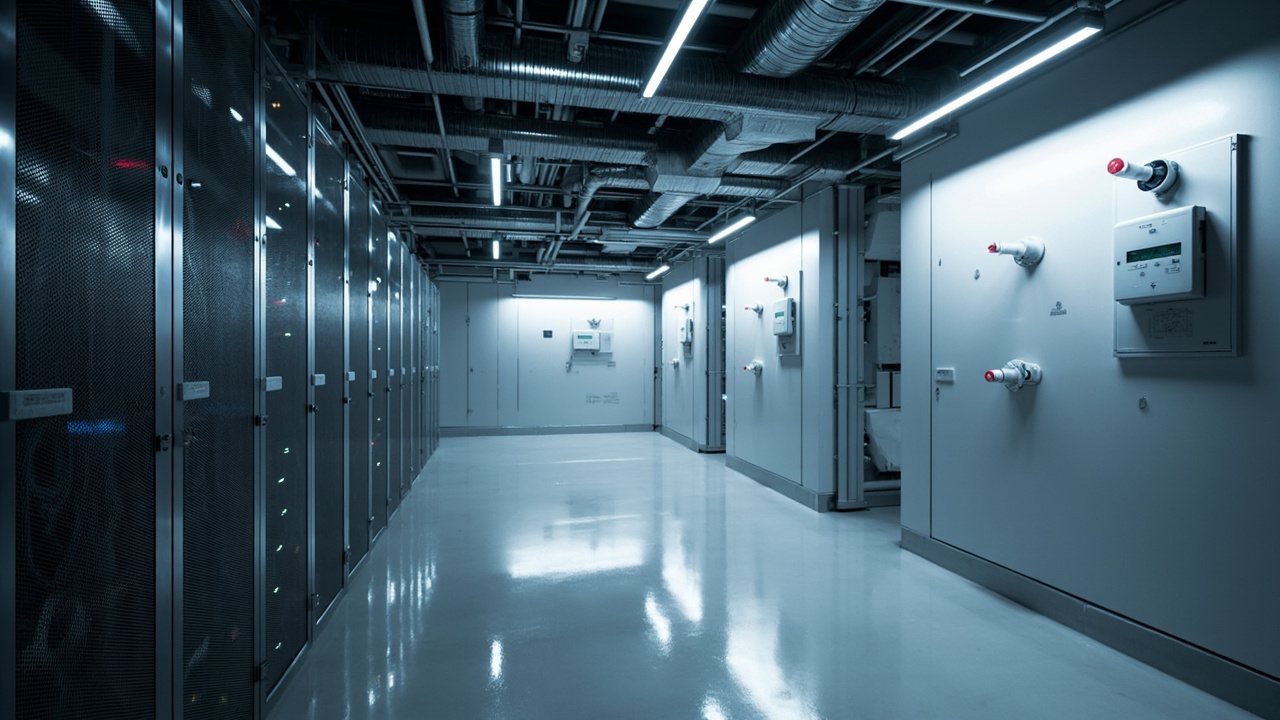
TL;DR: Large-scale fire testing by Equinix, Delta Electronics and FM is producing new containment designs and certification guidance for lithium-ion UPS units in data centers.
Data centers are rethinking backup-battery safety after a multi-year test program focused on lithium-ion uninterruptible power supply systems. The newest verified fact on Sept. 9, 2026, is that results from a research partnership between Equinix, Delta Electronics and FM are headed toward a new safety certification for lithium-ion backup power units, according to reporting in Testing Advances Safety Designs for Lithium-ion UPS Systems.
The three companies presented their research at Data Center World 2026 in Washington, D.C. Charles Chang, Director of Sales at Delta Electronics, discussed the joint fire-protection research with FM and Equinix at the event. The work centers on large-scale fire test data intended to make lithium-ion UPS installations safer to deploy and operate.
Why lithium-ion took over UPS rooms
Lithium-ion batteries have become a leading choice for uninterruptible power supply systems in data centers, as described in Testing Advances Safety Designs for Lithium-ion UPS Systems. They are typically lighter and occupy less space than lead-acid batteries, which were the standard choice for many years.
That shift followed long consumer use in smartphones and laptops. In the last 10 years, lithium-ion has been adopted in UPS systems, which keep IT workloads online during grid power outages until generators can take over. For preparedness planners, the implication is direct: the same chemistry backing up home offices and small server closets now backs up hyperscale halls.
The trade-off is heat behavior. When a cell overheats, it can trigger thermal runaway, in some cases releasing flammable gas. If that gas builds up and finds a spark, the result can be a fire or even an explosion. The report notes a number of incidents in recent years in which fires at data center campuses have been attributed to lithium-ion batteries.
What Equinix, Delta and FM tested
The Equinix, Delta Electronics and FM partnership ran large-scale fire tests to study how lithium-ion backup units burn and how enclosures, spacing and suppression can limit damage. According to Testing Advances Safety Designs for Lithium-ion UPS Systems, the multi-year effort was designed to produce practical design guidance to contain data center fires.
Presentation at Data Center World 2026 in Washington, D.C. put the findings before operators, engineers and safety specialists. The goal outlined there was not to declare lithium-ion risk-free, but to define tested configurations that reduce propagation between cabinets and rooms.
For off-grid and backup-power users, the lesson is to treat containment as part of the system. Battery selection alone does not determine outcome. Cabinet design, separation, ventilation and detection determine whether a single-cell failure remains an equipment loss or becomes a structure fire.
OCP guidance widens the safety checklist
A second track of guidance arrived earlier in 2026 for the full energy-storage lifecycle. On Sept. 8, 2026, Americase International announced that Mike Pagel, Principal Consultant with its HazMat Safety Consulting subsidiary and a contributing author to the Open Compute Project white paper, helped inform dangerous-goods and regulatory sections, as detailed in Americase International Regulatory Expert Contributes to OCP Guidance on Data Center Energy Storage Safety.
The January 2026 white paper, titled Requirements for Energy Storage Systems Used in Data Centers, provides guidance for safe design, operation and maintenance of Energy Storage Systems used in data centers as AI and high-performance computing increase power density, load variability and infrastructure complexity.
The paper covers configurations from rack-level battery backup units, known as BBUs, to centralized uninterruptible power supply systems and larger battery energy storage systems, known as BESS. It addresses battery chemistry, testing, fire protection, transportation, emergency response and end-of-life management.
That scope matters for preparedness because safety extends beyond installation. Batteries and battery-powered equipment may also be subject to transportation, testing, packaging, documentation, emergency response and end-of-life requirements across their lifecycle.
Test the system, not just the chemistry
A central message from the OCP work is that chemistry labels do not predict behavior. Pagel said form factor and chemistry produce materially different hazards, adding that testing is the only way to know performance.
In the announcement, Pagel stated:
“Calling something a lithium battery tells you almost nothing about how it will actually behave.”
The guidance therefore treats testing as central. Standards such as the National Fire Protection Association NFPA 855 establish safety requirements, while testing such as under UL 9540A helps evaluate how a system responds to thermal runaway, rather than assuming behavior based on battery type alone.
The OCP guidance examines lithium-ion, nickel-zinc, lead-acid, sodium-ion and supercapacitor systems, each with different risk profiles based on chemistry, system architecture and application. It also addresses higher-voltage power architectures and the electrical and stored-energy hazards requiring specialized controls, training and qualified personnel.
Testing and validation references include NFPA 855 requirements for energy storage systems and ANSI/CAN/UL 9540A 5th Edition (2025) for evaluating thermal runaway and fire propagation characteristics. For lithium-ion systems, the guidance also addresses detection, mitigation and emergency response strategies associated with thermal runaway and fire risk.
Transport and lifecycle rules operators miss
The Americase International Regulatory Expert Contributes to OCP Guidance on Data Center Energy Storage Safety announcement emphasizes dangerous-goods transportation requirements, including packaging, marking, labeling, documentation and training obligations for lithium batteries and battery-powered equipment.
Applicable requirements can include testing, packaging, marking, labeling, documentation and training, as well as successful completion of UN Manual of Tests and Criteria, Part III, Sub-section 38.3 testing for lithium battery design types. The guidance highlights transportation requirements for lithium-ion batteries and battery-powered equipment, including data center battery backup units that may fall under dangerous goods regulations.
Those requirements can apply at multiple points in the equipment lifecycle, including initial deployment, replacement, return, repair, redeployment and end-of-life shipment. HazMat Safety Consulting advises organizations on regulatory requirements for transportation, storage and handling of lithium batteries and other dangerous goods, while Americase and Fulcrum Testing provide packaging, containment and testing capabilities.
For homesteads, retreats and small businesses storing spare UPS modules, the practical point is to keep original packaging, labels and shipping papers, and to check carrier rules before moving damaged or used lithium units.
Lead-acid rooms still need hydrogen control
Not every backup room has converted to lithium. Lead-acid batteries generate hydrogen, and boost charging and overcharging generate even more, according to Battery Room Monitoring: The Gases, Temperatures and Signals That Precede a UPS Failure.
Because hydrogen is odorless, colorless and lighter than air, it pools silently at the ceiling. Fire codes dictate that accumulation cannot exceed 25 percent of the lower explosive limit, which equates to a 1 percent ambient hydrogen concentration. IEEE 1635 and ASHRAE Guideline 21 provide the ventilation math to prevent accumulation based on battery count, chemistry and charging mode.
The article warns that code compliance is a baseline, not a strategy. A localized hydrogen detector and an exhaust fan protect a facility only if the fan actuates and the alarm reaches an operator. Facility monitoring systems must track detector health, fan run status and unacknowledged trips.
Electrical drift warns weeks ahead
The most common lead-acid failures are quiet, electrical and cumulative, the monitoring report explains. A corroded intercell connection creates high resistance and generates heat under load. Cell-level temperature, voltage and current monitoring tracks degradation curves, catching failing connections months before they open during a discharge cycle.
A weak block drags down the entire string during discharge but hides during float. When charging current climbs while float voltage remains constant, VRLA strings are entering thermal runaway. Heat raises current, and current raises heat. Tracking string-level telemetry catches drift early.
Ambient temperature is the cheapest insurance. Lead-acid lifespan halves for every 8 degrees Celsius above the rated 25 C, making rack-level ambient monitoring critical against premature aging and stranded capacity.
Sealed chemistries need gas sensing, not just ventilation
Lithium-ion and sodium-ion architectures do not generate hydrogen under normal charging conditions, according to Battery Room Monitoring: The Gases, Temperatures and Signals That Precede a UPS Failure. That shift retires standard ventilation calculations for new builds, but it makes abnormal gas detection more valuable.
Before a lithium-ion cell enters full thermal runaway, it vents electrolyte vapor. That cocktail includes volatile organic compounds, carbon monoxide, hydrogen and hydrocarbons. UL Fire Safety Research Institute data confirms that off-gas sensing provides exceptional early warning. Detection precedes flammable concentrations by over 10 minutes at nominal charge rates.
Interlocking volatile organic compound sensors with charging shutdown and ventilation logic provides an intervention window of up to 30 minutes. That operational logic is driving NFPA 855 requirements and UL 9540A test methods for runaway propagation. Sodium-ion systems vent at lower temperatures and release less energy, but early fleets lack extensive field history, so the report calls for more data, not less.