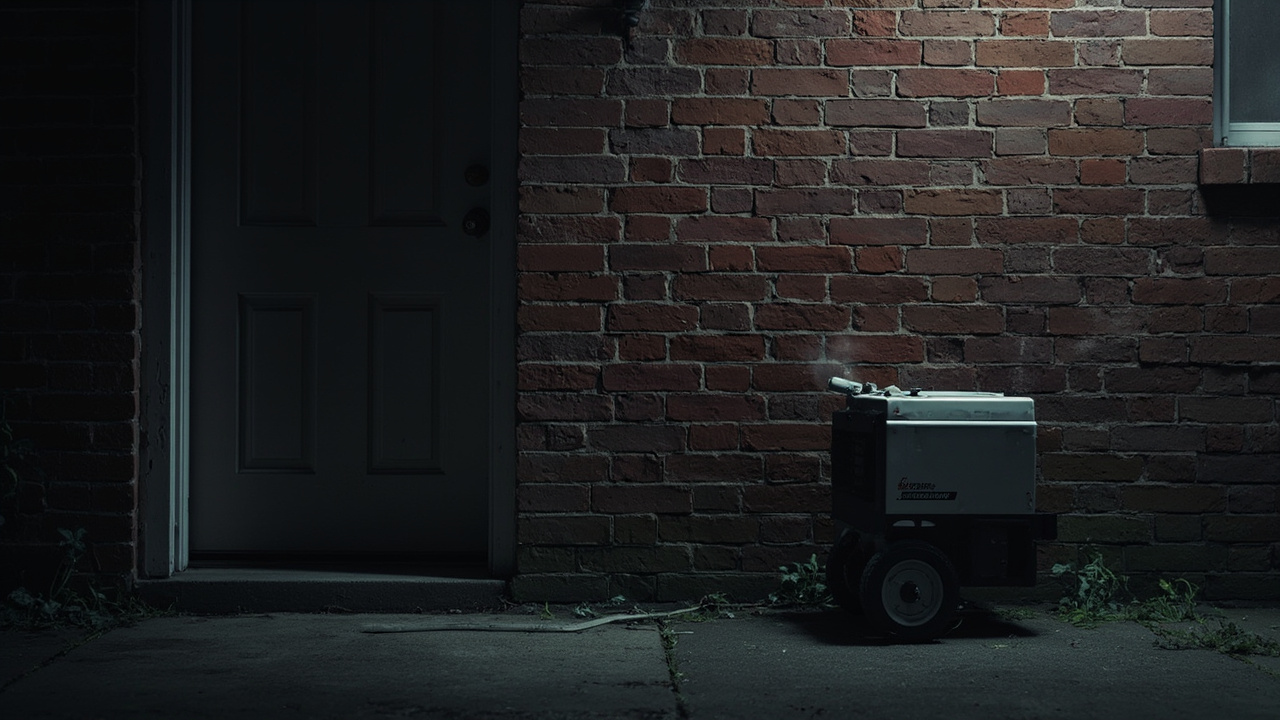
TL;DR: A generator certified to ANSI/PGMA G300-2018 was operating outside a Louisiana home but close enough for exhaust to enter and kill three people.
On April 22, 2022, U.S. Consumer Product Safety Commission staff transmitted a letter via email to Mr. Joseph Harding, Technical Director of the Portable Generator Manufacturers’ Association at 1300 Sumner Avenue in Cleveland, Ohio, according to the CPSC staff letter to PGMA 4-22-2022 with enclosure. The letter was signed by Janet Buyer, Mechanical Engineer, Project Manager for Portable Generators in the Directorate for Engineering Sciences. The letter provided an enclosed redacted CPSC in-depth investigation report concerning carbon monoxide poisoning deaths of a woman and her two children from a generator certified to the PGMA G300-2018 standard. The letter stated the generator was reportedly purchased new just before the incident and was operating outside but next to the house. The letter stated the incident exemplifies one of the limitations of PGMA G300-2018 in protecting against certain hazard scenarios. The letter noted the information was prepared by CPSC staff, had not been reviewed or approved by, and may not necessarily reflect the views of the Commission. A copy was addressed to Jacqueline Campbell, CPSC Voluntary Standards Coordinator.
What investigators documented in Louisiana
The enclosed report was identified as Task Number 211104HCC3123, according to the same CPSC staff letter to PGMA 4-22-2022 with enclosure. The epidemiologic investigation report listed Investigator ID 9096 and Office Code 800. The date of accident was listed as September 2021 and the date initiated as December 1, 2021. The report was reviewed on February 16, 2022, by reviewer 9071, under Regional Office Director Beverly J. Kohen. Distribution was listed as Janet L. Buyer and Matthew V. Hnatov, with Source Document Number X21A0049A.
The synopsis stated a 54-year-old female and her two children, a 17-year-old male and a 23-year-old female, died of carbon monoxide toxicity after a generator was placed too close to an exterior door, causing a buildup of carbon monoxide in the home. The area was experiencing a power outage after being impacted by a hurricane. The generator was being used to provide power. A family member had placed the generator alongside the home, with the exhaust pointing toward the exterior door. Officials reported the generator was not running when they arrived and the fuel tank was empty. The home was not equipped with carbon monoxide detectors.
The location was listed as home in the state of Louisiana. The first product was listed as generators or power plants, and the second product was listed as gasoline. The report listed the victim’s race as Black/African American, age 54, disposition death, injury diagnosis anoxia, and body part involved all of body. The respondent was listed as second-hand information only, the type of investigation as telephone, time spent as 22.00 operational hours and 0.00 travel hours, exhibits as multiple exhibits, and case source as newspaper.
How the generator was set up before the incident
The investigation was initiated as a result of a news article that reported a family of three died of carbon monoxide poisoning, according to the same enclosure. The report stated a portable generator had been placed too close to the home, allowing carbon monoxide to build up inside. Information in the report was obtained from the sheriff’s office and the coroner’s office. Photos of the generator taken by the responding sheriff’s office were obtained. The responding detective was interviewed by telephone. Attempts to obtain the fire investigation report were unsuccessful. Attempts to contact the victims’ next of kin were unsuccessful.
The involved product was identified as a portable generator. The report stated the involved generator was assembled by a family member. The report stated the involved generator is equipped with carbon monoxide shutdown that shuts down the generator when harmful levels of carbon monoxide are present. The report stated the generator complies with ANSI/PGMA G300-2018. Photos obtained from the responding sheriff’s office showed the hazard label was affixed to the top of the involved generator. Photos also showed the generator was equipped with a carbon monoxide cut-off feature.
The victims were identified as a 54-year-old female, her 23-year-old daughter, and her 17-year-old son. The victims lived in a single-story home. The victims lived in an area affected by Hurricane Ida, which caused a power outage in their home. The home was not equipped with carbon monoxide detectors.
In September 2021, the victim’s ex-husband and father of the two younger victims purchased the involved generator from a local retailer. He assembled the generator and placed it alongside the home. The generator was positioned approximately 3 inches to 5 inches off the brick veneer wall and approximately 10 inches from an exterior door on the side of the home. The exhaust end was positioned near the door. A 25-foot extension cord provided with the generator was plugged into a receptacle on the generator. An air-conditioning unit, portable fan and refrigerator were plugged into the extension cord. The victim’s ex-husband reported that when he left the residence, the generator was running and operating correctly.
What responders found after the restart request
According to the sheriff’s report summarized in the enclosure, the victim’s ex-husband stated he received a text message from his 17-year-old son in September 2021 asking how to restart the generator. The enclosure’s synopsis stated officials found the generator not running on arrival and the fuel tank empty. The enclosure stated the fire department response and detective interview supplied the placement measurements and operating account.
A later meeting record revisited placement details, according to the Meeting Log - PGMA mtg 1-12-2023. The meeting took place January 12, 2023, by teleconference via WebEx, with the log entered January 13, 2023, by Janet Buyer of Engineering Sciences. CPSC attendees included Janet Buyer, Caroleene Paul, Barbara Little, Matt Brookman, Stephen Hanway, Tim Smith, Jose Tejeda and David Olson. Non-CPSC attendees included Joe Harding and Susan Oregna of PGMA and representatives identified with Multiquip, American Honda, Champion, Bracewell, Webster Chamberlain & Bean, TTi, Firman, Yamaha, Generac, Duromax, Harbor Freight, GenTent and others. The meeting was requested by PGMA. The agenda included the fatal incident involving three carbon monoxide deaths from a PGMA G300-2018 certified portable generator operating outside a home, compliance with PGMA G300-2018, PGMA’s proposed revision, and PGMA’s Take it Outside information and education campaign.
At that meeting, PGMA stated that, based on photos provided by the responding sheriff’s office, although the portable generator was located outside the residence, it was touching the home wall and oriented such that exhaust emissions were directly adjacent to and pointing into the door behind the security screen door. CPSC staff pointed to investigation and sheriff’s report information: the technician who took photos arrived after many others had already been on scene; the responding detective reported the generator was approximately 3 to 5 inches off the brick veneer wall and approximately 10 inches from an exterior door, with the exhaust end near the door; the fire department found all windows and doors closed and locked and had to force entry; one scene photo showed another door farther down the wall with its security door opened; and scene photos appeared to show the security door near the generator location as having glass panels rather than screening.
Why CPSC staff said the standard did not prevent this outcome
CPSC staff’s broader assessment of portable generator standards is described in the Briefing Package on Assessment of Portable Generator Voluntary Standards’ Effectiveness in Addressing CO Hazard, and Information on Availability of Compliant Portable Generators. The briefing package contact was Janet Buyer, Project Manager, Directorate for Engineering Sciences. The package stated portable generators are useful when utility power is interrupted or unavailable, but almost all generator engines emit very high rates of carbon monoxide, and use in or near enclosed areas can quickly become fatal. It stated CPSC databases contain many records of fatal incidents commonly involving a generator at home in living space, an attached garage, basement or crawlspace. It stated the average fatality rate over the 11-year period 2010 through 2020 was 64 deaths per year when only a generator was involved and 68 deaths per year when a generator and another carbon monoxide-producing product was involved. It stated three-quarters of carbon monoxide deaths were single-fatality incidents and one-quarter were multiple-fatality incidents, some involving entire families. It stated a relatively small number of reported incidents involved a generator used outdoors.
The package stated that in November 2016 the Commission issued a notice of proposed rulemaking to limit carbon monoxide emission rates of portable generators. It stated that in 2018 two ANSI-approved voluntary standards, ANSI/PGMA G300-2018 Safety and Performance of Portable Generators and UL 2201 Standard for Safety for Carbon Monoxide Emission Rate of Portable Generators Second Edition, adopted hazard-mitigation requirements. Both standards require generators to shut off when certain concentrations of carbon monoxide are present around the generator. UL 2201 also requires a specific, relatively lower emission rate compared with current generators.
Staff evaluated the standards with the National Institute of Standards and Technology using an indoor air quality modeling program called CONTAM, according to the same briefing package. CONTAM simulated a 24-hour period during which a noncompliant baseline generator emitted carbon monoxide at a specified rate at a specified indoor location for a specified number of hours representing run time on a full tank. It simulated accumulation and transport throughout the house while emitting and continued transport after fuel exhaustion. For compliant generators, it started operation in the same indoor location, stopped emissions if concentrations reached shutoff criteria, then continued with no restart, restart after 10 minutes in the same location, or restart in a new indoor or outdoor location, with a second outdoor restart if an indoor restart stopped again. Restarted compliant generators operated until the tank was empty. Concentrations were used to calculate carboxyhemoglobin levels for theoretical occupants. The program completed approximately 140,000 simulations for 37 house models and three detached garages, with various generator locations and sizes in 28 weather conditions. The simulations replicated 511 fatalities in CPSC databases.
What the simulations and marketplace review found
CPSC summarized results in a February 23, 2022 announcement titled New CPSC Report Finds Industry Voluntary Standards Can Reduce Risk of Carbon Monoxide Death and Injury from Portable Generators, Yet Compliance with Standards Is Minimal; Supports Mandatory Rulemaking Process. The announcement stated the staff report included analysis of the effectiveness of two industry voluntary standards and a review of marketplace compliance. It stated staff concluded that, to differing degrees, both standards mitigated the hazard. It stated some compliant generators were available for sale, but there was not a high level of compliance in the marketplace. It stated staff recommended proceeding with the mandatory rulemaking process. It stated staff analyzed more than 140,000 simulations of 511 portable generator fatalities in CPSC databases.
The briefing package analysis found generators compliant with PGMA G300 would avert nearly 87 percent of deaths that occurred with baseline generators, with 55 survivors requiring hospitalization and 34 survivors seeking medical treatment, while the February 2022 announcement stated generators compliant with UL 2201 would avert nearly 100 percent of deaths that occurred with noncompliant generators, with three survivors predicted to require hospitalization. The Consumer Product Safety Act discussion in the briefing package stated the agency is prohibited from issuing a final rule under section 9 if a voluntary standard exists whose requirements will eliminate or adequately reduce the risk and substantial compliance is likely.
In later comments, CPSC staff addressed outdoor operation directly. In a May 12, 2023 letter to Mr. Joseph Harding concerning BSR/PGMA G300-202x, CPSC staff voted negative on proposed revisions and stated the changes were inadequate for foreseeable patterns including generators outdoors near living spaces with exhaust infiltrating living spaces and certain attached-garage configurations with the garage door open. Staff stated performance requirements in the Supplemental Notice of Proposed Rulemaking published at 88 Fed. Reg. 24346 on April 20, 2023, were necessary and recommended those for PGMA G300. Staff assessed PGMA’s modeling supporting a change from 800 ppm to 600 ppm and PGMA’s statement that ANSI/PGMA G300-2018 is 99 percent effective as incorrect. Staff stated PGMA used modeling from the 2016 notice published at 81 Fed. Reg. 8355, which was not appropriate for evaluating a shutoff-sensor approach for reasons described in National Institute of Standards and Technology Technical Note 2202. Staff stated PGMA’s modeling did not include generator-outside scenarios with carbon monoxide entering the house, although staff modeling for the voluntary standards and supplemental proposal included them. Staff stated fatality data for 2004 through 2021 showed 6 percent of 1,332 consumers who died were killed by generators operating outside. For the same period, staff estimated 77,658 consumers had medically attended carbon monoxide injuries from generators and assessed at least some occurred in that scenario. Staff stated a generator with shutoff but without emission-rate reduction does not provide protection when used outside, carbon monoxide infiltrates inside, and shutoff does not activate. Staff cited the PGMA G300-certified generator that caused the deaths of a family of three as a real-life example. Staff also described a case study in the greater New Orleans area after Hurricane Ida power outages in Fall 2021, finding at least 63 homes had carbon monoxide inside from portable generators operating outside, with residents in six homes feeling ill with one or more symptoms.