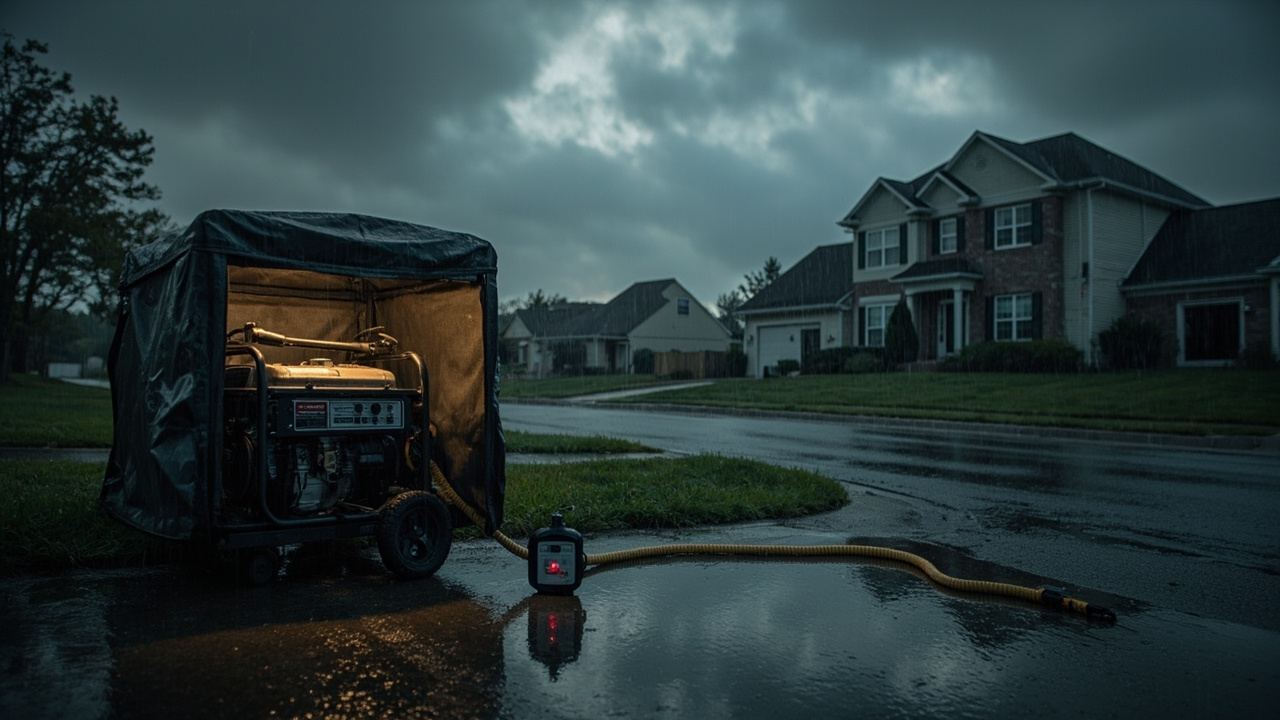
TL;DR: Run a portable generator outdoors only, at least 20 feet from the house with exhaust pointed away, with working CO alarms inside, dry power cords, and refueling only after shutdown and cooldown.
The core placement answer
Federal guidance converges on one placement standard for portable units during outages. According to How to Run a Generator Safely, the U.S. Consumer Product Safety Commission says never use a portable generator inside a home, garage, basement, crawlspace, shed, or other enclosed area, even if doors or windows are open. The same source reports the operating instruction as outdoors only, at least 20 feet from homes and buildings, with exhaust directed away from windows, doors, and vents.
That 20-foot separation is repeated across preparedness agencies. According to How to Run a Generator Safely, Ready.gov says generators, camp stoves, or charcoal grills should always be used outdoors and at least 20 feet away from windows. Its generator list adds at least 20 feet from windows, doors, and attached garages, alongside keeping the generator dry, connecting appliances with heavy-duty extension cords, and letting the unit cool before refueling because fuel spilled on hot engine parts can ignite.
FEMA’s generator graphic carries the same layout message. According to How to Run a Generator Safely, FEMA says only use it outside at least 20 feet from homes and garages, never plug it into a wall outlet or main electrical panel, and keep the exhaust pointed away from the home.
Why 20 feet outdoors is not optional
CPSC data show generators are the single product under its jurisdiction linked to the most carbon monoxide deaths. According to Portable Generator Safety: Placement, CO, Fuel and Rain, CPSC estimates generators alone were involved in 892 deaths from 2012 to 2022, or 41% of all non-fire CO deaths from consumer products it oversees. Its CO center puts the number above 100 a year. The same report cites CPSC records of 789 generator-related CO deaths from 2012 to 2022.
A 55-second CPSC public service announcement explains the exposure scale. According to Portable Generator Safety: Placement, CO, Fuel and Rain, the announcement says one portable generator can produce as much carbon monoxide as hundreds of cars, that the gas can’t be seen or smelled and can kill a family in minutes, and gives the core rules of never running a generator indoors, placing it outside at least 20 feet from the home, and keeping working CO alarms on every floor and outside sleeping areas. CPSC’s 2026 hurricane-season warning calls portable generators one of the leading causes of post-storm carbon monoxide deaths, and calls carbon monoxide a colorless, odorless gas that can kill within minutes, according to How to Run a Generator Safely.
Where fatal units were running
CPSC staff completed in-depth investigations for most deaths. According to Portable Generator Safety: Placement, CO, Fuel and Rain, its latest generator report covers 553 deaths in houses, mobile homes and apartments. In 73% of them the generator was running inside the home itself, and in another 18% it was in an attached garage, an enclosed carport or an attached barn.
The location breakdown is detailed in the agency’s Table 13. According to Portable Generator Safety: Placement, CO, Fuel and Rain, living space including bedroom, den, living room and enclosed porch accounted for 221 deaths and 40%, basement or crawlspace accounted for 99 deaths and 18%, and attached garage, enclosed carport or attached barn accounted for 99 deaths and 18%. Inside the house with room not reported accounted for 58 deaths and 10%, closet, laundry room, utility room or hallway accounted for 25 deaths and 5%, outdoors near an open window, door or vent accounted for 28 deaths and 5%, unknown location at the home accounted for 22 deaths and 4%, and outside an apartment but inside the building accounted for 3 deaths and 1%.
Victims were often not next to the machine. According to Portable Generator Safety: Placement, CO, Fuel and Rain, of 440 home deaths where CPSC knew where the victim was, only 24% happened in the same room as the generator. Homes were small, with a median of about 1,290 square feet, and 64% of incidents were in homes under 1,500 square feet. CPSC says it is unclear whether that reflects income, faster CO buildup in a smaller space, or both.
Open doors and fans do not make indoor use safe
Opening a garage door or window feels like ventilation. According to Portable Generator Safety: Placement, CO, Fuel and Rain, a third of deaths with known ventilation status happened with windows or doors open, fans running or the generator just outside an opening. The key takeaways checked Oct. 4, 2026 state ventilating doesn’t make it safe.
OSHA guidance reinforces that warning. According to How to Run a Generator Safely, OSHA’s portable-generator fact sheet says never use a generator indoors or in enclosed spaces such as garages, crawl spaces, and basements, and that open windows and doors may not prevent CO from building up. It also says not to place a unit outdoors where doors, windows, and vents could let CO into occupied rooms.
Do not confuse equipment clearance with house separation. According to How to Run a Generator Safely, OSHA says make sure a generator has 3 to 4 feet of clear space on all sides and above it so it can ventilate. That 3 to 4 feet is clearance around the machine. It is not a shorter substitute for CPSC’s 20 feet from the house.
CO alarms on every level
Where alarm status was known, absence of an alarm was common. According to Portable Generator Safety: Placement, CO, Fuel and Rain, 83% of generator CO deaths happened with no CO alarm. The report’s guidance is to use battery or battery-backup alarms on every level and test them monthly.
Pre-outage preparation makes alarm protection functional when power fails. According to Generator Safety Tips: Placement, CO and Fuel, install carbon monoxide detectors on every level of the home and outside each sleeping area, and replace batteries on a schedule. Use detectors that meet current safety standards, choose battery-powered or plug-in models with battery backup so they work during an outage, and test them before starting the generator.
Some newer portable generators include an automatic CO shut-off that stops the engine if levels build around it. According to Generator Safety Tips: Placement, CO and Fuel, that feature does not replace home alarms. Early symptoms such as headache, dizziness, nausea, and fatigue feel like flu or exhaustion, which is why people often go to sleep instead of getting out. If any detector sounds or anyone feels sick, get everyone outside to fresh air immediately and call 911, and do not go back in until responders say it is safe.
Fuel handling and refueling cooldown
Gasoline vapors are heavier than air and ignite easily from a hot muffler, spark, or pilot light. According to Generator Safety Tips: Placement, CO and Fuel, shut the generator off and let it cool for at least 15 to 20 minutes before refueling. Spilling gas on a hot engine is a common cause of generator fires. OSHA also says shut the generator down and let it cool before refueling, because gasoline can ignite on hot engine parts, according to How to Run a Generator Safely.
Safe refueling is an outdoor task. According to Generator Safety Tips: Placement, CO and Fuel, refuel outdoors with a funnel or spill-proof spout, and wipe up spills before restarting. Store fuel in approved containers, outside the living space and away from water heaters, furnaces, and anything with a pilot light or open flame. Add fuel stabilizer to stored gasoline and rotate it every few months. Keep a fire extinguisher rated for flammable liquids nearby.
Propane and dual-fuel units need connection checks. According to Generator Safety Tips: Placement, CO and Fuel, inspect hoses and regulators for cracks, check connections with soapy water for bubbles, and keep cylinders upright and outdoors. If you smell gas around a fixed propane or natural gas line, leave the area and call the gas utility. Connections to household gas lines are licensed-professional work only.
Rain, cords, and house connections
Water raises shock risk, so placement must balance dry operation with CO separation. According to How to Run a Generator Safely, Ready.gov adds keeping the generator dry and connecting appliances with heavy-duty extension cords. FEMA says never plug a generator into a wall outlet. According to Generator Safety Tips: Placement, CO and Fuel, never plug a generator into a wall outlet, and never use a double-male cord. That practice, called backfeeding, can energize utility lines and electrocute line workers or neighbors.
Cord selection starts with outdoor rating and adequate capacity. According to Generator Safety Tips: Placement, CO and Fuel, use outdoor-rated, three-prong extension cords with a wattage or amp rating above the load you plan to run. A common guide is 14-gauge for light loads up to about 1,500 watts on shorter runs, 12-gauge for heavier loads or runs over 25 feet, and 10-gauge for large appliances or longer distances.
Set the unit for stability and heat dissipation. According to Generator Safety Tips: Placement, CO and Fuel, set it on a firm, level surface so it cannot tip and spill fuel. Give it breathing room, usually several feet of clearance on all sides for cooling and away from anything combustible such as dry grass, woodpiles, or fences. Keep it downwind of the house when possible, and away from neighbors’ windows and air intakes too.
Connecting to house wiring requires a professional. According to How to Run a Generator Safely, connecting to house wiring instead of plugging appliances in with a heavy-duty cord needs a transfer switch installed by a licensed electrician and a permit where local code requires one. According to Portable Generator Safety: Placement, CO, Fuel and Rain, connecting a generator to home wiring is a job for a licensed electrician. If a CO alarm sounds or anyone feels dizzy or sick, get outside to fresh air, then call 911.
When risk peaks and how to prepare
Deaths peak from November to February at 44%, according to Portable Generator Safety: Placement, CO, Fuel and Rain. Before the next outage, read the owner’s manual for clearances, fuel type, oil requirements, and outlet ratings, according to Generator Safety Tips: Placement, CO and Fuel. Do a test run every month or two, outdoors, for 15 to 20 minutes under a light load. Plan a location at least 20 feet from the house, and check that cords reach from there. Buy the right cords or have a licensed electrician install an inlet and transfer switch or interlock. Store fuel safely in approved containers with stabilizer, away from living spaces. Keep a printed copy with the generator.