TL;DR: Battery Energy Storage Systems stabilize the grid but lithium-ion fires are hard to extinguish, can reignite, release hazardous gases, and require specialized cleanup, so the U.S. Environmental Protection Agency urges pre-planned siting, monitoring, responder coordination, isolation, and let-it-burn containment tactics.
What BESS Are and Why Communities Want Them
Battery Energy Storage Systems, or BESS, help stabilize electrical grids by providing steady power flow despite fluctuations from inconsistent generation of renewable energy sources and other disruptions, according to the U.S. Environmental Protection Agency's page titled Battery Energy Storage Systems: Main Considerations for Safe Installation and Incident Response | US EPA.
That stabilizing role explains why storage is expanding alongside solar and wind. An Energy Storage System is a device or group of devices assembled together, capable of storing energy in order to supply electrical energy at a later time, and battery ESS are the most common type of new installation, according to the National Fire Protection Association's ENERGY STORAGE SYSTEMS SAFETY FACT SHEET.
Battery storage capacity in the United States was expected to more than double between 2022 and 2025 from 9.4 GW to 20.8 GW, according to the U.S. Energy Information Administration as cited in that NFPA fact sheet.
The uses cited by NFPA include supplementing renewables, peak shaving, load leveling, and uninterruptible power supply. Renewable energies such as solar panels or wind turbines only produce electricity when the sun is out or the wind is blowing, and supplementing these with ESS allows users to take advantage of electricity generated when renewable technologies are not producing electricity.
Peak shaving allows a user to shift where electricity comes from by drawing power from batteries during higher-cost daytime hours then recharging during lower-cost nighttime hours. Load leveling means ESS can help flatten out the demand curve by charging when electrical demand is low and discharging when demand is high.
ESS can provide near instantaneous protection from power interruptions and are often used in hospitals, data centers, and homes, according to the same NFPA fact sheet. For households and neighborhoods focused on emergency preparedness and survival, that backup function is the attraction: steady flow of power to homes and businesses regardless of fluctuations from varied energy sources or other disruptions.
Why Lithium-Ion BESS Fires Challenge Responders
While BESS technology is designed to bolster grid reliability, lithium battery fires at some installations have raised legitimate safety concerns in many communities, according to the U.S. Environmental Protection Agency.
The agency lists three central challenges for host communities and first responders. Fire suppression is difficult because lithium battery fires are extremely difficult to extinguish and may reignite hours or days later. Emissions from battery fires can release harmful gases that pose health risks to nearby residents and first responders. Environmental impact follows because proper cleanup and disposal of damaged batteries requires specialized procedures.
The NFPA fact sheet describes the underlying mechanism as thermal runaway, a term used for the rapid uncontrolled release of heat energy from a battery cell when a battery creates more heat than it can effectively dissipate. Thermal runaway in a single cell can result in a chain reaction that heats up neighboring cells, and as that process continues it can result in a battery fire or explosion.
What makes these events distinct from ordinary structure fires is stranded energy. As with most electrical equipment there is a shock hazard present, but what is unique about ESS is that often, even after being involved in a fire, there is still energy within the ESS, according to NFPA. That residual energy is difficult to discharge since terminals are often damaged, presents a hazard to those performing overhaul after a fire, and can cause reignition of the fire hours, days, or even weeks later.
Most batteries create toxic and flammable gases when they undergo thermal runaway, according to NFPA. If those gases do not ignite before the lower explosive limit is reached, it can lead to creation of an explosive atmosphere inside an ESS room or container.
ESS fires are also deep seated. ESS are usually comprised of batteries housed in a protective metal or plastic casing within larger cabinets, and those layers help prevent damage but can also block water from accessing the seat of the fire. That means large amounts of water are needed to dissipate heat because cooling the hottest part of the fire is often difficult.
Failure Modes That Can Start Thermal Runaway
Mechanical, Thermal, Electrical, and Environmental Causes
The NFPA fact sheet groups failure modes that often lead to thermal runaway and subsequent fires or explosions into four categories.
Mechanical abuse can happen when a battery is physically compromised by being dropped, crushed, or penetrated. Thermal abuse can occur when a battery is exposed to external heat sources.
Electrical abuse can happen when the battery is overcharged, charged too rapidly or at high voltage, or discharged too rapidly. Environmental impacts that can lead to battery failure include seismic activity, rodent damage to wiring, extreme heat, and floods.
Communities should consult BESS safety experts when considering and designing installations, according to the U.S. Environmental Protection Agency. The agency also notes that despite some high-profile incidents, improvements in BESS quality and design have led to a decrease in the number of failure incidents per gigawatt hour deployed.
Global grid-scale storage deployment and failure statistics cited by EPA come from the Electric Power Research Institute in 2024. Since 2020, BESS failure incidents have decreased, but some recent fires have gained attention in the media.
Two California Fires EPA Highlights
Gateway Energy Storage Facility, San Diego
On May 15, 2024, Gateway Energy Storage Facility in San Diego, California, experienced a BESS fire with continued flare-ups for seven days following the fire, according to the U.S. Environmental Protection Agency.
The facility held about 15,000 nickel manganese cobalt lithium-ion batteries. Following the incident, EPA has required the Gateway facility to conduct extensive environmental monitoring during battery handling and disposal operations and submit detailed work plans and progress reports.
Moss Landing Site, Monterey County
On January 16, 2025, a BESS fire broke out at the Moss Landing site in Monterey County, California, resulting in a 24-hour evacuation of about 1,200 residents, according to the U.S. Environmental Protection Agency.
A joint effort among company personnel and the North County Fire Department kept the fire contained to one building, though with one notable flare-up. Air quality monitoring and sampling occurred during and after the fire and found no risks to public health.
Following the incident, EPA continues to work with other regulators to ensure the safe storage, handling, and transportation of undamaged batteries remaining at the Moss Landing site. Clear and comprehensive incident response plans are critical when managing BESS sites to ensure preparedness in the event of a battery fire, the agency states.
Installation Considerations Before a BESS Goes In
Proactive safety measures can be included in a BESS site design to minimize the risk of a BESS fire, according to the U.S. Environmental Protection Agency. The agency lists four considerations before installing a BESS.
First, comply with state and local siting, zoning, marking, and permitting requirements to ensure site suitability. Second, consider the design of BESS units, including battery chemistry, manufacturing quality assurance and quality checks, unit design, battery management system analytic capabilities, and system integration, and consult the most recent industry safety standards.
Third, include remote sensors and monitoring such as infrared, thermal, and fire detection. Fourth, communicate with local first responders to develop emergency response plans for incidents.
For designers and installers, NFPA adds equipment-level safeguards. If there are enough batteries in a room to create an explosive atmosphere, then explosion prevention systems or deflagration venting should be installed per NFPA 68, Standard on Explosion Protection by Deflagration Venting, and NFPA 69, Standard on Explosion Prevention Systems.
Testing has shown water to be the most effective medium for cooling an ESS fire, and a sprinkler system that complies with NFPA 13, Standard for the Installation of Sprinkler Systems, should be installed in buildings where an ESS is installed, according to the NFPA fact sheet.
A battery management system is described by NFPA as a critical system that should be used in an ESS to monitor, control, and optimize performance of an individual or multiple battery modules and that can control disconnection of modules from the system in abnormal conditions. ESS units should be grouped into small segments limited to certain kilowatt hours and spaced from other segments and walls to prevent horizontal propagation.
Incident Response Considerations for BESS Fires
Protection, Isolation, and Containment Strategy
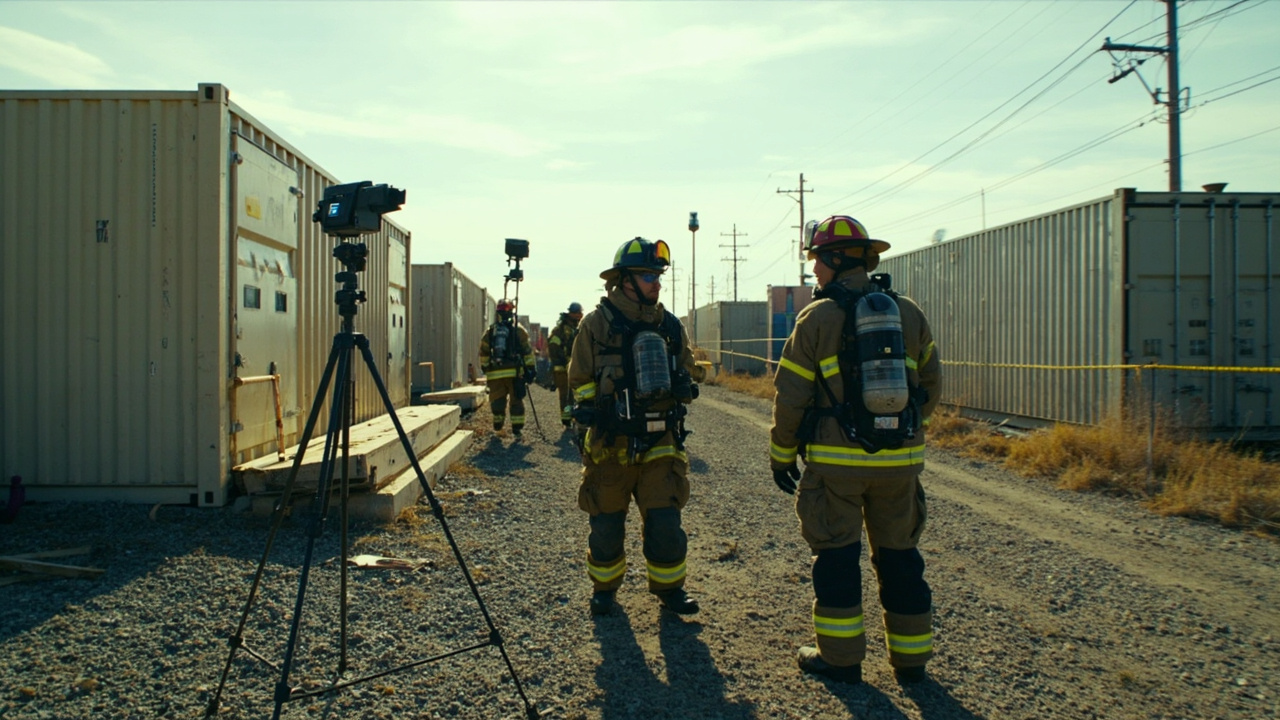
When developing an incident response plan for BESS, EPA advises ensuring use of personal protective equipment including self-contained breathing apparatuses to protect against hazardous air emissions.
For large commercial BESS, EPA advises setting an isolation zone that is at least 330 feet, depending on the site. Responders should be positioned upwind and uphill. Planners should evaluate the need for community shelter-in-place or evacuation, depending on the incident and site.
Current guidance is to focus the response on preventing the spread of fire. EPA directs fire crews to let the fire burn itself out and to use water to prevent the spread of fire to neighboring batteries or other structures. Research is ongoing into the most effective method of water application to prevent spread.
Air Monitoring and Runoff Control
EPA advises assessing hazardous air emissions during response. Responders should use modeling to guide on-site decision making and initially monitor for hydrogen, carbon monoxide, hydrogen fluoride, hydrogen cyanide, and hydrogen chloride.
As an incident extends, responders should sample air for metals and other combustion byproducts of burning plastics. EPA also advises minimizing, containing, and redirecting runoff from water application, to the extent possible.
EPA states that its webpage includes information from first responder and industry guidance as well as background information on battery energy storage systems and resources, and describes the document as a non-comprehensive collection of existing research and guidance. In recent years, first responder and industry associations have developed guidance to help communities identify focus areas when planning a BESS, including how to work with local responders to improve incident preparedness.