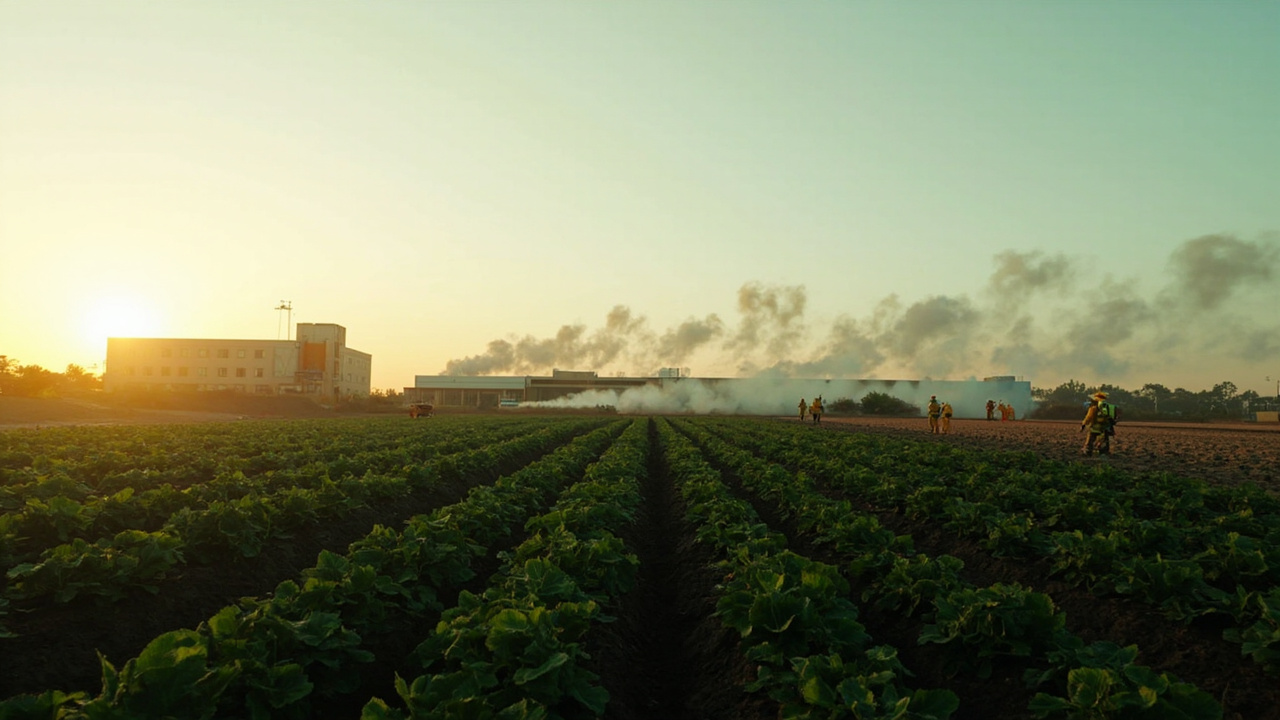
TL;DR: Damaged, still-energized batteries left from the January 2025 Moss Landing fire caught fire again on Sept. 18, 2026, triggering a shelter-in-place order that was later lifted with no injuries reported.
The Sept. 18 flare-up at Vistra's Moss Landing battery plant did not become a second large-scale disaster, but it forced a familiar emergency response and renewed questions about large battery sites near homes, farms, and Central Valley communities.
What happened on Sept. 18
Crews were dispatched to a structure fire at the Moss Landing Power Plant at about 6:15 a.m. Friday, Sept. 18, 2026, according to CBS San Francisco. Firefighters arriving at the Monterey County coastal plant found smoke and fire coming from the north side of the facility, the same battery complex damaged in January 2025.
The plant is owned by Vistra Corp., a Texas-based operator, according to CalMatters. Workers for Vistra noticed the flare-up against the wall of a building destroyed in the earlier fire, CalMatters reported.
Monterey County emergency managers ordered nearby residents to shelter in place, close windows and doors, bring animals indoors, and shut off heating and air-conditioning systems. CBS San Francisco reported the affected zones were MRY-B047, MRY-B050 and MRY-B053. The county order covered roughly one-third of a mile around 7301 Highway 1, according to NBC Bay Area.
Plant employees were evacuated while firefighters stabilized the site, CBS San Francisco reported. Schools in the immediate area were initially told to keep students and staff inside, then later allowed outdoor activity, according to NBC Bay Area.
The shelter-in-place order was lifted at about 4 p.m. Friday, CBS San Francisco and NBC Bay Area reported. No injuries were reported in connection with the fire.
Division Chief Jess Cortez of the North County Fire Protection District said there was no active fire by Friday afternoon, describing the material as hot and smoldering, according to CBS San Francisco. County officials said the fire was expected to burn itself out over roughly 24 hours, with control achieved Friday afternoon and full burnout anticipated by Saturday, according to NBC Bay Area and Canary Media.
Why damaged batteries reignited
The new fire involved batteries that were previously damaged in the January 2025 blaze and had not yet been removed, Monterey County said, according to Canary Media. County officials stressed the event was not comparable in size to the earlier fire.
About 1,500 hard-to-access batteries remained on the property, Assemblymember Dawn Addis said, according to CBS San Francisco and NBC Bay Area. NBC Bay Area reported that Vistra plant manager Ron George said those batteries were still energized but idle, and that the unit had been disconnected from the electric grid after the 2025 fire.
Access was the central problem. Fire Chief Jess Cortez said the batteries were inaccessible after the 2025 fire because they sat along a wall at risk of collapse, according to NBC Bay Area. Cortez said the best tactic was to let the batteries burn themselves out.
Vistra built the Moss Landing system on the California coast south of Santa Cruz to supply capacity to the greater Silicon Valley region, according to Canary Media. It was the world's most powerful grid battery when it came online in 2020, with 300 megawatts and 1,200 megawatt-hours packed into a former gas turbine hall, Canary Media reported.
That enclosed reuse of a former turbine building is now viewed as outdated. Unlike newer projects that use spaced modular containers designed to prevent fire spread, the Moss Landing site placed older-technology cells closely together inside an aging building, according to CalMatters.
The chemistry also differed from current practice. Moss Landing used nickel-manganese-cobalt lithium-ion cells derived from electric-vehicle designs, while the stationary-storage industry has largely shifted to lithium ferrous phosphate, a less energy-dense but more stable chemistry built on dedicated factory lines, according to Canary Media.
The January 2025 fire had already been severe. The 300-megawatt system involved held about 100,000 lithium-ion batteries, with about 55% damaged by that fire, according to CBS San Francisco. That event led to evacuation of 1,200 nearby residents and a state of emergency declaration, CBS San Francisco reported.
Cleanup was already underway
The September flare-up occurred during an EPA-overseen demolition and removal effort. The U.S. Environmental Protection Agency said personnel were at the site working with the fire department and had been overseeing removal of battery modules following the 2025 fire, according to CBS San Francisco. When the flare-up broke out, an EPA-approved emergency response plan was activated, CBS San Francisco reported.
In July 2025, EPA entered an agreement with Vistra to remove damaged batteries from the property, according to CBS San Francisco. Vistra had been laboriously extracting intact batteries, de-energizing them, and shipping them for recycling or disposal, according to Canary Media. Workers had already extracted 34,000 battery modules and hoped to finish the last 5,000 modules later in the year, Canary Media reported.
EPA said earlier in September that it was starting the final phase of battery cleanup and demolition of the storage building and would take precautions to mitigate on-site fire risk, according to NBC Bay Area. Before the Sept. 18 fire, EPA had estimated battery removal and building demolition would be complete by mid-2027, NBC Bay Area reported.
Vistra said the on-site natural gas plant was temporarily shut down as a precaution and that air-quality monitors were active along the site perimeter and in the surrounding community, according to a Monterey County publication account of the company statement.
Air monitoring did not show dangerous readings during the Friday incident. EPA said air monitoring stations at the site and nearby community detected no hydrogen fluoride gas and no PM2.5 exceedances, according to CBS San Francisco. EPA and Monterey Bay Air Resources District sensors did not show readings out of the ordinary, while light winds and a marine layer kept smoke from spreading far, according to NBC Bay Area.
Why the Central Valley is paying attention
The repeat fire drew attention well beyond Monterey County, including in Kings County where multiple battery storage facilities are located. Community members raised questions about safety of Valley storage sites after Moss Landing caught fire again, according to FOX26 KMPH.
Kings County Fire Marshal John Wilson told FOX26 KMPH that battery fires are especially difficult to fight because water is not always effective and the fires can reignite. Lithium-ion batteries of the type found in laptops, phones and portable chargers can enter thermal runaway when exposed to heat, Wilson said, according to FOX26 KMPH.
"When that happens, our water is not effective on extinguishing or putting out that chemical process going on within the battery itself," Wilson said, according to FOX26 KMPH.
Wilson said Kings County focuses on planning and permitting to keep facilities safely built and sited away from sensitive areas, according to FOX26 KMPH. He said the county places facilities where they are not directly next to a home or school and spends time on wind patterns and pre-planning.
He also said crews maintain fire roads and grass heights and conduct training drills with company employees, according to FOX26 KMPH.
Even with those measures, Wilson said codes struggle to keep pace with changing battery products. Code cycles generally have difficulty keeping up with how often battery systems and related products change in pursuit of efficiency, he said, according to FOX26 KMPH.
Another local concern is whether a major battery fire could stretch fire resources and leave fewer crews for other emergencies. FOX26 KMPH reported that Wilson said the county is working to secure more resources, and that one county supervisor has proposed asking storage owners to provide upfront funding for fire resources.
What this means for household preparedness
For preparedness-minded households, the Moss Landing repeat event is a reminder that utility-scale battery emergencies follow a different pattern than wildfires or house fires. Shelter-in-place orders may arrive with instructions to close windows and doors and turn off air systems, as Monterey County directed on Sept. 18, according to CBS San Francisco.
Residents living near any industrial battery site can learn their county alert zones in advance. Monterey County used specific zone codes and an online county alert page during the incident, a system that let officials lift orders zone by zone rather than across a wide area.
Home battery owners face a smaller-scale version of the same thermal-runaway risk described by Kings County officials. General fire-service guidance is to follow manufacturer installation and ventilation instructions, keep household lithium-ion devices away from heat, and call emergency services rather than attempting to fight a swelling or burning battery.
The broader investigation remains unresolved. The cause of the January 2025 fire was still unknown, with a root-cause analysis underway in coordination with Vistra and an independent consultant, a Public Utilities Commission spokesperson told CalMatters. Until removal is complete, Vistra's plant manager acknowledged the possibility of future flare-ups like the one on Sept. 18, according to NBC Bay Area.