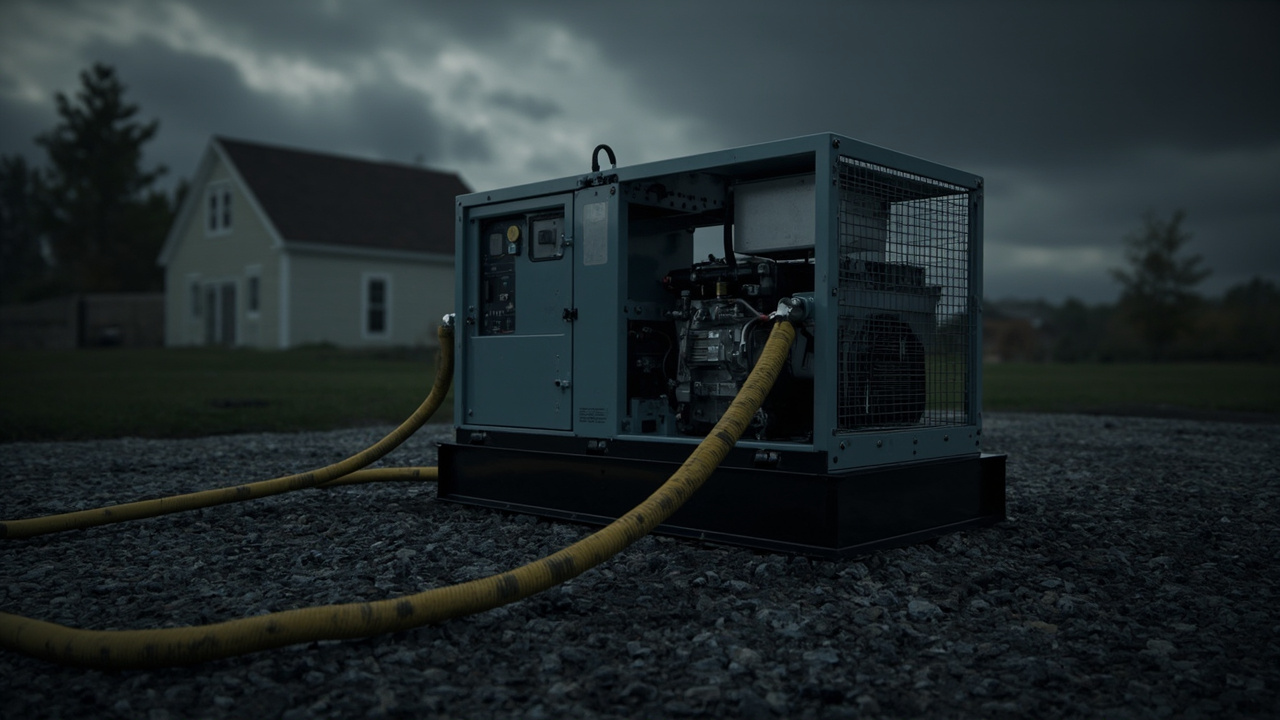
TL;DR: Place any fuel-powered portable generator outdoors at least 20 feet from homes and buildings, aim exhaust away from every opening, and complete load, cord, and connection planning before an outage begins.
Portable power helps households hold food, lighting, communications, and medical equipment through a blackout, but placement errors create fast-moving carbon-monoxide, fire, shock, and backfeed dangers. The newest verified guidance in this archive, published Aug. 26 by Smart Homeowners, states the boundary plainly: operate outdoors only, at least 20 feet from homes and buildings, with exhaust directed away from windows, doors, and vents.
That distance is not a suggestion to adjust for convenience. According to Smart Homeowners, a porch, carport, shed, crawlspace, basement, or garage does not meet the boundary, even with a door open. The same report stresses that a generator should never be connected to home wiring except through equipment installed for that purpose by a qualified electrician.
Why the 20-foot outdoor boundary matters
Combustion exhaust contains carbon monoxide, a colorless and odorless gas that can incapacitate and injure before occupants recognize the problem. Coverage republished Aug. 21 by Tucson.com from the USA Today Network explains that operating a unit inside or too close to a dwelling can lead to poisoning, while contact with a hot machine can cause burns.
Children face elevated concern. That Tucson.com report notes that younger occupants absorb more of the gas into the bloodstream, breathe faster, and have higher metabolic rates than adults, making them more susceptible to poisoning.
Built-in safety systems do not change the distance rule. The Tucson.com account, citing Consumer Reports testing, describes newer models that sense elevated carbon monoxide near the machine and shut down. Paolo Fu, the engineer who leads generator testing for Consumer Reports, cautioned that the sensor reacts only to conditions around the generator itself. If exhaust reaches another part of a dwelling, concentrations there may become hazardous before the onboard device responds.
A separate preparedness guide published Aug. 25 by Anker SOLIX likewise advises choosing the operating spot before the outage, placing the machine outdoors at least 20 feet from the home when possible, and pointing exhaust away from doors, windows, vents, crawl spaces, attached garages, and neighboring houses.
Map the spot while the lights are on
Stress and darkness produce poor decisions. Smart Homeowners urges households to select a level outdoor location in advance, confirm the full 20-foot separation from homes and buildings, direct exhaust away from every nearby opening, and keep the unit clear of floodwater.
Draw the area on paper. Mark the intended generator pad plus nearby doors, windows, vents, garages, and low ground where water collects. Include neighboring openings where wind could push fumes. Anker SOLIX recommends a firm, flat, level surface elevated above puddles, mud, runoff, and floodwater, with a stable platform that prevents tipping and keeps outlets away from pooling water.
Airflow around the machine also needs attention. Anker SOLIX suggests keeping at least 5 feet of clearance on all sides when possible, unless the manufacturer manual requires more, and avoiding placement against siding, fences, shrubs, vehicles, or storage bins that trap heat or exhaust.
If wind, rain, standing water, or available clearance makes the planned spot unsafe, the answer is not to move the machine into shelter. According to Smart Homeowners, the correct response is to leave the generator off and use the household outage plan.
Build an outage load card
A written load card prevents midnight overload decisions. Smart Homeowners recommends listing every appliance and device the household expects to support, including medical equipment, then checking running and starting wattage from manuals or equipment labels.
Do not assume one portable unit can carry every circuit at once. Motor and compressor loads often need a short surge at startup above their continuous draw, so continuous and starting requirements should be recorded separately. Smart Homeowners advises writing the exact essential loads, their label or manual values, the order in which they will be connected, and what stays off.
That discipline matters because large heating, cooling, drying, and water-heating loads can exceed portable capacity. A homeowner outage guide published Aug. 23 by CircuitFixer explains that central air conditioning, electric dryers, ovens, and electric water heaters demand much more power than many portable generators can safely provide, while a refrigerator, limited lights, phone charger, sump pump, or medical device may be more realistic priorities.
Keep the card with the generator manual, cords, fuel supplies, and emergency contacts. Include shutdown and restart order so no one reconnects household circuits by guesswork when utility power returns.
Cords, outlets, and transfer equipment
How electricity reaches the house determines shock and backfeed risk. For temporary use, Smart Homeowners advises outdoor-rated cords in good condition and dry connections.
The Tucson.com report adds practical cord checks drawn from Consumer Reports: when an extension cord is necessary, it should be a heavy-duty outdoor type rated in watts or amps at least equal to the combined load of connected appliances. The entire cord should be free of cuts, and the plug should retain all three prongs, a detail described as important for shock protection if water has entered equipment.
Plugging appliances directly into the generator is often the simplest temporary arrangement. Anker SOLIX describes direct connection as a common approach for refrigerators, freezers, chargers, modems, and limited lights, with cords routed away from water, door pinch points, and walkways.
Anything involving home circuits requires professional equipment. Smart Homeowners states that a transfer switch, inlet, or panel connection requires a qualified electrician and equipment designed for the particular generator and electrical system. Anker SOLIX similarly says households that intend to power selected home circuits should hire a licensed electrician to install an approved transfer switch or interlock system that meets local code, preferably before storm season, because the device isolates the home from utility lines.
The Tucson.com account reports that installing that critical connection may cost $300 to $900, including labor, for a 5,000-watt generator or larger. It explains that the switch connects the generator to the circuit panel, allows selected hardwired appliances to operate, reduces reliance on extension cords, and that many models display wattage use to help avoid overload.
Never backfeed the house
Backfeeding means attempting to energize home wiring by plugging a generator into a wall outlet. Smart Homeowners warns against wall-outlet connections and improvised double-male cords.
The danger extends beyond the house. According to Smart Homeowners, backfeeding can energize utility lines and harm workers, neighbors, and the home electrical system. The Tucson.com report adds that the practice presents an electrocution risk to the operator, utility workers, and neighbors served by the same transformer, bypasses some household circuit protection, and may damage electronics or start a fire.
Keep the unit dry without trapping exhaust
Rain, puddles, wet hands, damaged cords, and standing water increase shock risk. Anker SOLIX warns against standing in water while operating a generator and advises shutting the unit down if electrical components become soaked or unsafe to reach.
Do not solve rain exposure with an enclosed shelter. The Tucson.com report says portable units should not run in rain without protection, but protection should come from a generator tent or shield that remains ventilated, available online and through home centers and hardware stores.
Anker SOLIX likewise limits safe wet-weather operation to a generator-rated running cover, fire-resistant tent, or open canopy designed to protect outlets and electrical parts while preserving airflow. Tarps, plastic sheets, and tight homemade covers can trap heat, block exhaust, touch hot surfaces, or sag into moving parts. If a cover restricts ventilation, it is not safe storm protection, according to that guide.
Smart Homeowners similarly allows weather protection only when it does not enclose the generator or restrict exhaust, and directs users to follow manufacturer instructions. Keep hands dry, wear dry shoes with traction, stand on a dry surface, and shut the machine off before adjusting equipment in rain.
Floodwater is a stop-work signal. Reporting Aug. 21 by Mirror Indy on Indiana flood cleanup advises that a generator exposed to standing water should be turned off immediately and disconnected from all power sources.
Fuel, start-up, operation, and shutdown
Fuel handling begins with a cool engine. Smart Homeowners directs operators to turn the generator off, allow it to cool, and refuel outdoors. Fuel should remain in an approved container away from living areas and ignition sources, consistent with local fire guidance and the manual.
The Tucson.com report gives the reason: gasoline spilled on a hot engine can ignite, while a cooling interval also lowers burn risk during refueling. Households expecting extended operation should maintain extra gasoline and store it properly.
Start-up and loading should follow the owner manual. Smart Homeowners advises following instructions for startup, load management, grounding, and maintenance, keeping children and pets away, and never operating equipment that is damaged, wet, overheating, or showing an unfamiliar warning.
Shutdown needs the same order. According to Smart Homeowners, operators should disconnect loads as directed, switch the unit off, allow cooling, then refuel only if needed. When utility service returns, use installed transfer equipment properly rather than improvising circuit connections.
Keep carbon-monoxide alarms active
Household alarms are a backup warning, not permission to shorten the distance. Smart Homeowners describes working indoor carbon-monoxide alarms as a second line of warning. If an alarm sounds, occupants should go outside and call emergency services.
Ken Boyce, senior director and principal engineering at UL Solutions, quoted by Tucson.com, recommended operating a working battery-powered carbon-monoxide detector at the same time as a generator. Boyce said such an alarm supplies another layer of defense against an innocent but potentially deadly mistake.
Anker SOLIX recommends battery-powered detectors on every level of the home because wind can shift fumes after placement. A detailed portable-generator reference published Aug. 21 by PortableGenerators.co likewise places working alarms with battery backup on each level and outside sleeping areas, while emphasizing that generator shutoff technology does not replace household alarms.
Know when professional help is required
Some conditions should stop do-it-yourself work. Smart Homeowners advises stopping when the situation involves active gas leaks, damaged service wiring, structural movement, unsafe heights, suspected contamination, or a problem the household cannot confidently isolate.
The same principle applies to electrical connections. Transfer equipment, panel work, and utility interaction belong to qualified or licensed electricians under applicable codes and utility requirements. Planning those installations before storm season avoids dangerous improvisation after the power fails.
Sources referenced
- Portable generator safety: the 20-foot rule and a pre-outage plan | Smart Homeowners (https://www.smarthomeowners.com/articles/portable-generator-safety-boundaries)
- Using a generator? Experts say keep these safety tips in mind - Tucson.com / USA Today Network (https://tucson.com/life-entertainment/nation-world/home-gardening/article_fe2fe0b5-2f0b-5100-8096-051b0772c608.html)