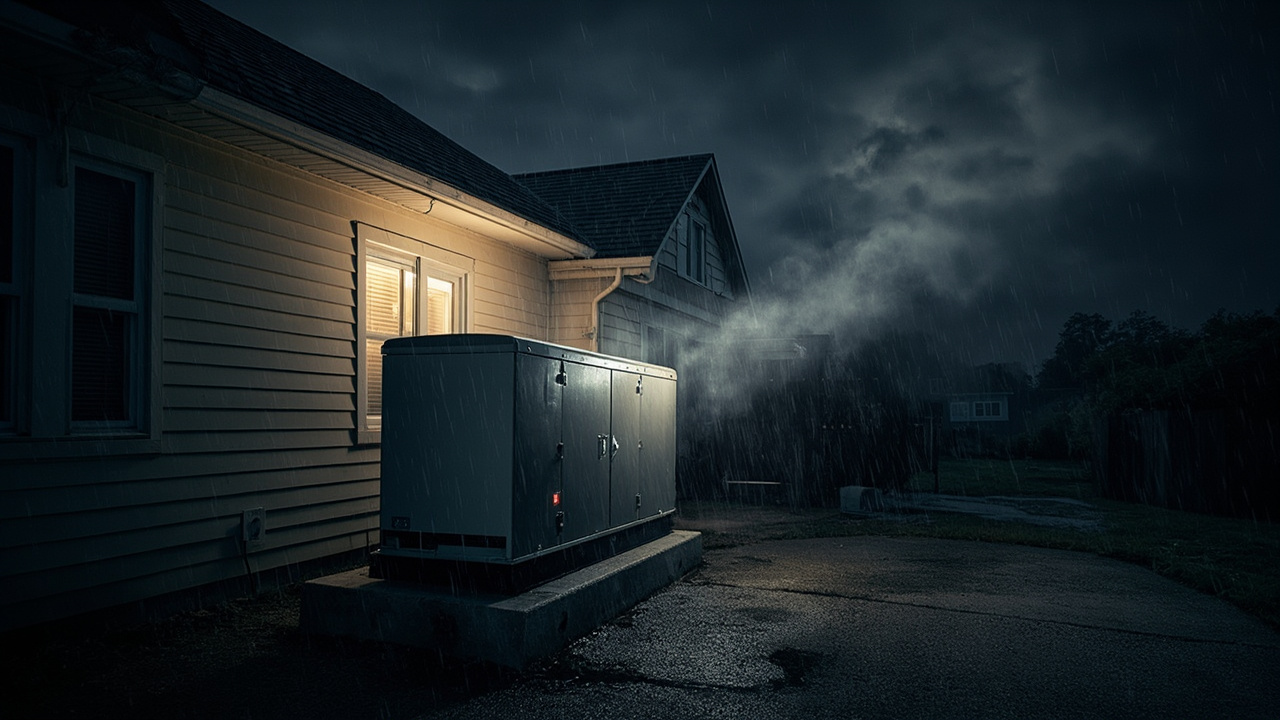
TL;DR: A code-legal 5-foot pad still poisoned the air inside 105 homes.
A permanently installed home generator placed 5 feet from an opening met the installation rule, yet federal investigators confirmed that same arrangement as the carbon monoxide source in 105 southeast Louisiana homes after Hurricane Ida left power off for days, according to the federal 31-page document released in June 2025 described in the Energies Media report on the Louisiana investigation.
The storm came ashore in southeast Louisiana in late August 2021 as a Category 4 and cut power to 1.2 million customers. Federal staff later collected reports of carbon monoxide exposure from 256 homes in the affected area. In 105 of them a permanently installed generator was confirmed as the source, while portable machines were the source in 65 more, the type could not be determined in 35, and the source was never identified in 52.
How hot exhaust climbed to the roofline
A plume measured beyond 25 feet
Measurements around running units show the exhaust plume traveling at least 25 feet from the enclosure, spreading sideways by at least 6 feet, and rising more than 10 feet, past 20 feet when something in the way pushes it up, as detailed in the Energies Media report on the Louisiana investigation.
That height puts the diluted exhaust level with the roofline of a single-story house. Exhaust leaves the enclosure hot, and hot air climbs. When a fence, wall, shrub row, or neighboring structure blocks horizontal flow, the stream deflects upward.
The house openings that pull it inside
Under the overhang of almost any roof runs a long perforated strip of aluminum. That is the soffit vent, and its whole job is to pull outside air into the attic. Dryer vents open the same way, so does the fresh air intake on a central air system, and so does a basement window left cracked in the heat.
None of those pathways distinguishes between fresh air and exhaust. The West Grove Fire Company warns that exhaust should never be located near windows, basement casement openings, or wall penetrations, and that even soffit vents can be risky because exhaust from air-cooled units can be pushed some distance, as described in its September 2, 2026 generator safety notice.
The same department found carbon monoxide inside two homes with permanently installed whole-house generators after Tuesday night thunderstorms caused extended outages. Wind direction and placement allowed exhaust to build up close enough to enter, and crews detected carbon monoxide levels inside on arrival. An easterly wind pushed exhaust back toward the homes.
What happened after Ida knocked out 1.2 million services
Alarms in houses where nothing was burning
After the storm the power stayed off for days, and everything that could make its own electricity ran around the clock. The state fire marshal's office began taking calls about alarms sounding in houses where nothing was burning. Then came calls about people who felt sick and could not say why.
Investigators went house by house, matching who was ill to what was running in the yard. In one home nine people fell ill on the same night. One of them spent the night in a hospital and eight others were checked and sent home.
A woman whose alarm woke her family said afterward that they had almost lost their entire immediate family and had not known it could happen. Her daughter told reporters you could wipe out generations in one quick breath.
The 256-home federal count
The federal collection covered 256 homes with reported carbon monoxide exposure. Stationary units accounted for 105 cases. Portable machines accounted for 65 cases. Another 35 cases involved an undetermined generator type. In 52 cases investigators never identified a source.
People in 12 of the 105 stationary-generator homes had symptoms. Ten of those households never sought care. No one died in the set.
The work ran four years and produced a 31-page document released in June 2025. Federal staff sent two written recommendations to the committee that owns the installation standard, including a recommendation for at least 25 feet of separation and a second recommendation that the engines be built to emit far less of the gas.
Why 5 feet passes inspection and 25 feet is recommended
The 5-foot number installers still use
The installation standard that governs these machines calls for 5 feet between the generator and an opening into the building. That is the number the installer works to and the permit office checks.
Placement rules described by RealCostIQ's standby generator sizing and placement guide list at least 5 feet from any operable window, door or fresh-air opening to keep exhaust out of the house. The same guide lists at least 3 feet from a detached combustible structure such as a shed or garage.
The guide also describes a separate combustible-wall rule. Clearance from the back of the generator to a combustible stationary wall or building is 5 feet by default. It can drop to 18 inches only if that specific unit is supported by Southwest Research Institute testing or the manufacturer's own listed installation instructions. Clearance at the front and both ends, including trees, shrubs and bushes, is addressed separately.
The 25-foot federal recommendation
Federal staff now recommend at least 25 feet, and put it in writing to the committee that owns that standard. Here is the limit of it. A recommendation is not a rule, the standard has not changed, and nobody counted how many of these units are already bolted down, so the size of the exposed group is simply unknown.
A quarter-acre lot rarely has 25 feet of side yard to give, which means the setback often lands closer to the neighbor's bedroom than to the owner's, as residents told investigators. Property-line setback is set locally, not by the national baseline, at roughly 3 feet in rural counties, 5 feet in most suburbs, and up to 10 feet or more in dense urban zones.
Noise rules can force a unit farther back regardless of fire or exhaust clearances. A typical air-cooled standby unit runs about 62-68 dBA at 7 meters. Many residential ordinances cap daytime property-line noise around 60-65 dBA and nighttime lower, around 45-55 dBA.
What preppers should do with pads already poured
Keep exhaust away from intakes
Put alarms on every level of the house, and keep the unit away from basement windows, dryer vents and soffit vents. On a big lot that is easy. On a small one it is close to impossible, and the alarm becomes the only thing standing between the family and the plume.
The West Grove Fire Company advises homeowners to make sure exhaust is designed to move away from a home and to consult an installation and service professional on proper exhaust techniques for whole-house generators. It also advises working carbon monoxide detectors with fresh batteries, and replacement of any detector older than 10 years since its manufacturing date.
For portable machines, federal guidance cited before Tropical Storm Edouard's approach called for outdoor operation at least 20 feet away from windows, doors and vents, according to the Beaumont Enterprise outage preparation report. The CDC says generators should never be operated inside a home, basement or garage, even with doors or windows open.
Check fuel, wiring, and alarm power before the outage
Every long outage sells more of these machines, and each one is installed to the rule that was in force the day the permit was pulled. What the Louisiana work established is a mechanism rather than a tally: a plume that goes further and climbs higher than the rule assumed, finding openings nobody thinks of as an inlet.
A September 3, 2026 homeowner account described in The Cooldown's standby generator safety report involved a Guardian 20-kilowatt standby generator that came with the property. The family reported shutting it down during an outage the prior week after carbon monoxide entered the house because of a loose spark plug connection, then moving it farther away. Other users replied that the new spot still looked too close to air-conditioning units, windows, vents and other openings.
Federal emergency guidance also calls for fully charging cellphones, laptops and portable power banks, gathering flashlights, headlamps and extra batteries, checking smoke and carbon monoxide alarms for working battery backup, keeping a battery-powered or hand-crank NOAA Weather Radio, and keeping refrigerators at 40 degrees or below and freezers at 0 degrees or below. An unopened refrigerator keeps food safe for up to four hours, a full freezer holds safe temperature for approximately 48 hours if the door remains closed, and a half-full freezer holds for approximately 24 hours.
What it leaves open is the harder half, which is what happens next to the machines already sitting on their pads, waiting for the power to go out again.