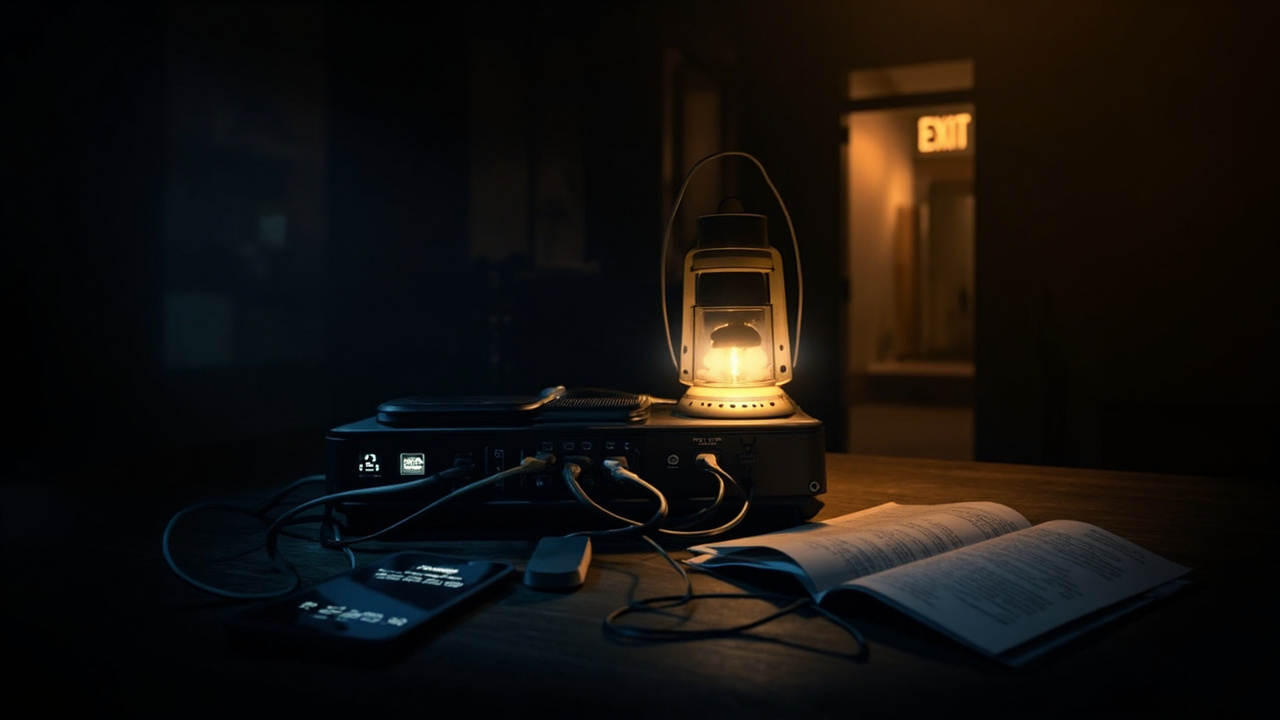
TL;DR: List the three devices you must keep running, confirm each device can connect to the battery and stay within its output limits, then test the real runtime before an outage — because watts decide what runs and watt-hours decide how long.
The newest verified planning guide, the Osprey Zero battery-power plan updated on 2026-10-03, tells households to list the devices they must support, check compatibility and test the real load before relying on a battery, while protecting exits and following the manufacturer's charging and storage instructions.
That short instruction reframes shopping. It is not about buying the largest box. According to the battery backup guide published as “Battery Backup for a Home Power Outage: Choose the Right System,” the choice starts with backing up the equipment you need, not every appliance you own, and checking two separate limits because watts determine what can run while watt-hours determine how long it can run.
A separate overview published as “Emergency Power Solutions for Homes and the Outdoors” makes the same point from outage data. It reports that about 33.9 million U.S. households, or one in four, experienced a complete power outage in the 12 months before the Census Bureau's 2023 survey, and roughly 70% of those households, about 23.6 million, reported an outage lasting at least six hours. Its practical rule is to identify critical loads first, then match battery capacity and fuel supply to runtime in hours, noting that peak watts matter for starting motors but watt-hours determine how long a kit lasts.
Decide what must stay on
Separate essentials from optional loads
The Osprey Zero battery-power plan directs households to separate essentials such as communications and suitable lighting from optional loads. Medical equipment needs a supplier-approved backup plan, not a generic consumer battery assumption.
That distinction matters for preparedness buying. A lantern may handle room lighting, a power bank may preserve phone access while a larger unit runs a router or medical device, and a fuel generator may support heavy loads, according to “Emergency Power Solutions for Homes and the Outdoors.” That overview also notes that a layered plan beats a single oversized purchase.
For medical needs, the guidance is stricter. According to “Battery Backup for a Home Power Outage: Choose the Right System,” if you depend on powered medical equipment to stay alive, seek emergency services immediately during an outage, and for backup planning the FDA’s medical-device outage guidance says to check the device instructions or contact its manufacturer about battery or generator compatibility. The Osprey Zero battery-power plan likewise warns not to extrapolate a brief test into a promise of overnight medical support.
Practical next step from the Osprey Zero battery-power plan: list three priority devices and verify their required connections.
Pick the right type of battery system
UPS, portable station, or installed battery
According to “Battery Backup for a Home Power Outage: Choose the Right System,” consider a UPS for short interruptions to electronics, a portable power station for plug-in essentials, or an installed battery system for household circuits.
Each has a different limitation. That guide explains that for a brief interruption to a computer or network equipment, a UPS should be checked for exact model runtime at your load, because VA is not battery capacity. A portable power station for selected plug-in appliances without altering house wiring is limited by outlet voltage, continuous output, motor-starting surge and stored energy. An installed home battery with backup equipment that automatically supplies selected household circuits requires professional design, installation and grid isolation.
Runtime expectations differ sharply. That same guide cites Schneider Electric’s UPS guide as describing typical home and office UPS runtime as roughly 5–20 minutes, depending on model and load, with smaller loads able to run longer. It advises using the manufacturer’s runtime chart rather than a universal minutes claim, staying within both watt and VA ratings, and using battery-backed outlets rather than surge-only outlets.
Installed systems add another decision. According to that guide, installed batteries can charge from the grid or solar, and solar is not required to store backup energy, but to recharge during a grid outage the battery needs a supported source that remains available.
Read output limits before you count capacity
Capacity and maximum output answer different questions
The Osprey Zero battery-power plan instructs readers to check output type, voltage, continuous output limits and device requirements, explaining that capacity and maximum output answer different questions and that a large capacity does not make every appliance compatible.
The outage-system guide gives the same warning in electrical terms. It tells readers to write down essentials, their running watts, starting requirements and required hours, to measure plug-in loads where practical, and for hardwired equipment to have the installer determine demand.
Checks it lists include continuous output to see whether the inverter can supply loads running together, starting surge to see whether it can start a refrigerator compressor or pump while other loads operate, voltage because a 120-volt outlet cannot directly supply a 240-volt appliance, and connection because plug-in appliances and hardwired household circuits need different arrangements.
Two cautions follow. According to that guide, do not substitute an advertised boost mode for compatible rated output, noting for example that the EcoFlow DELTA 2 manual warns that its X-Boost feature is incompatible with equipment that has strict voltage requirements. For cycling appliances, use energy measured over representative hours rather than compressor-on watts alone. The Osprey Zero battery-power plan adds that for a refrigerator or other cycling appliance, a brief power reading alone does not establish whole-day runtime.
Calculate runtime in watt-hours
Do the hours math, then add margin
Required energy in Wh equals average load in W multiplied by hours, with one kilowatt-hour equal to 1,000 watt-hours, according to “Battery Backup for a Home Power Outage: Choose the Right System.”
That guide offers arithmetic examples, not tested appliance runtimes: a 100 W average combined load corresponds to 2.4 kWh delivered to loads over 24 hours, 300 W corresponds to 7.2 kWh, 500 W corresponds to 12 kWh, and 1,500 W corresponds to 36 kWh.
It then works the 300 W example. At an average 300 W for 24 hours, 7.2 kWh must be delivered to the loads. If illustrating losses and unavailable energy by assuming 80% of nominal storage reaches the loads, that means 9 kWh of nominal storage before a contingency margin, with the 80% factor described as an example rather than a guaranteed efficiency or minimum runtime.
To estimate runtime instead, divide energy available to the loads in Wh by average load in W. The guide stresses keeping the output-power check separate, because enough stored energy does not guarantee that the inverter can start or run an appliance.
Real-world delivery varies. According to that guide, starting charge, reserve settings, battery age, temperature and inverter idle consumption affect available energy, and the Goal Zero Yeti 1000 and 1500 manual notes that active output ports consume energy even with nothing connected. It advises using model-specific usable-energy data where available, and if capacity is already stated as energy delivered at the AC output, not subtracting inverter losses again.
Build a device table and test under calm conditions
Record connections, cables and observed results
The Osprey Zero battery-power plan recommends making a device table before shopping with fields for device, required connection, normal use, intended backup period, compatible cable and tested result, including accessories.
Cables deserve the same attention as batteries. That plan notes that a charged power bank with the wrong cable cannot keep a phone working, and advises keeping compatible labeled cables, a small independent light and the manufacturer’s instructions for the actual model within reach.
Testing must happen before disruption. The plan tells households to try the intended devices and cables within manufacturer limits, record actual observed use and remaining capacity, and not plan around an untested marketing runtime. Its editorial test is to fully charge the suitable device, connect the actual appliance and cable, and record how long it serves the intended job under safe normal conditions, then repeat with the planned settings and keep the result alongside the manual.
Low-output endurance can change choices. According to “Emergency Power Solutions for Homes and the Outdoors,” independent runtime testing found one high-end solar rechargeable lantern delivered 250 hours at its dimmest setting, while other popular models lasted 39 to 54 hours under the same low-output benchmark.
Plan recharging and a fallback
Name the next charge, not just the battery
The Osprey Zero battery-power plan tells readers to name an actual accessible charging source and the conditions that could prevent using it. Solar input depends on equipment compatibility and available conditions, so it should be treated as variable until tested.
Keeping a smaller independent light and communications option avoids a single battery becoming the failure point for everything, according to that plan. If charging is unavailable, reduce optional loads and reserve remaining power for agreed essentials, and seek another safe setting early if a critical device cannot be supported for the needed period.
Context from outage history supports keeping a reserve. According to “Emergency Power Solutions for Homes and the Outdoors,” the U.S. Energy Information Administration reported that customers experienced an average of 11 hours of electricity interruptions in 2024, nearly twice the annual average of the prior decade, with major events including Hurricanes Beryl, Helene and Milton accounting for 80% of those outage hours.
Household roles help. The Osprey Zero battery-power plan says to teach the household which sockets and cables to use and who can change the setup, keep batteries away from children, and choose arrangements people can access without blocking doors.
Connect safely and watch for failure
No backfeeds, no improvised adapters
The common question addressed in the Osprey Zero battery-power plan is whether a portable battery can be connected to a wall outlet to power a house. Its answer is not to improvise a backfeed connection, because whole-home integration requires suitable equipment and qualified installation, and to use only the connections and loads permitted by the actual product instructions.
According to “Battery Backup for a Home Power Outage: Choose the Right System,” never feed battery output into a household wall outlet to energize the house, describing this as the same unsafe backfeeding connection method that the CPSC’s generator safety alert warns can electrocute utility workers and neighbors and bypass household circuit protection. That guide says to plug appliances into the portable unit as instructed, keep it dry and its ventilation openings clear following its manual, and for household circuits use manufacturer-supported transfer or islanding equipment installed by a qualified electrician.
If the battery itself shows trouble, stop using it. The Osprey Zero battery-power plan lists smoke, unusual heat, bulging, odors or noises as signals that can indicate battery trouble. If a battery fire occurs, evacuate and call emergency services when reachable, do not attempt improvised firefighting or handle a failing battery, and check recalls. Its trusted reference is listed as USFA Lithium-ion battery safety, with content updated and sources checked on 2026-10-03.
For safe charging routine, that plan advises using appropriate charging equipment and following product instructions, inspecting batteries for damage and keeping charging arrangements clear of escape routes. If the battery does not support the device, use a compatible alternative rather than defeating safety limits or improvising adapters.