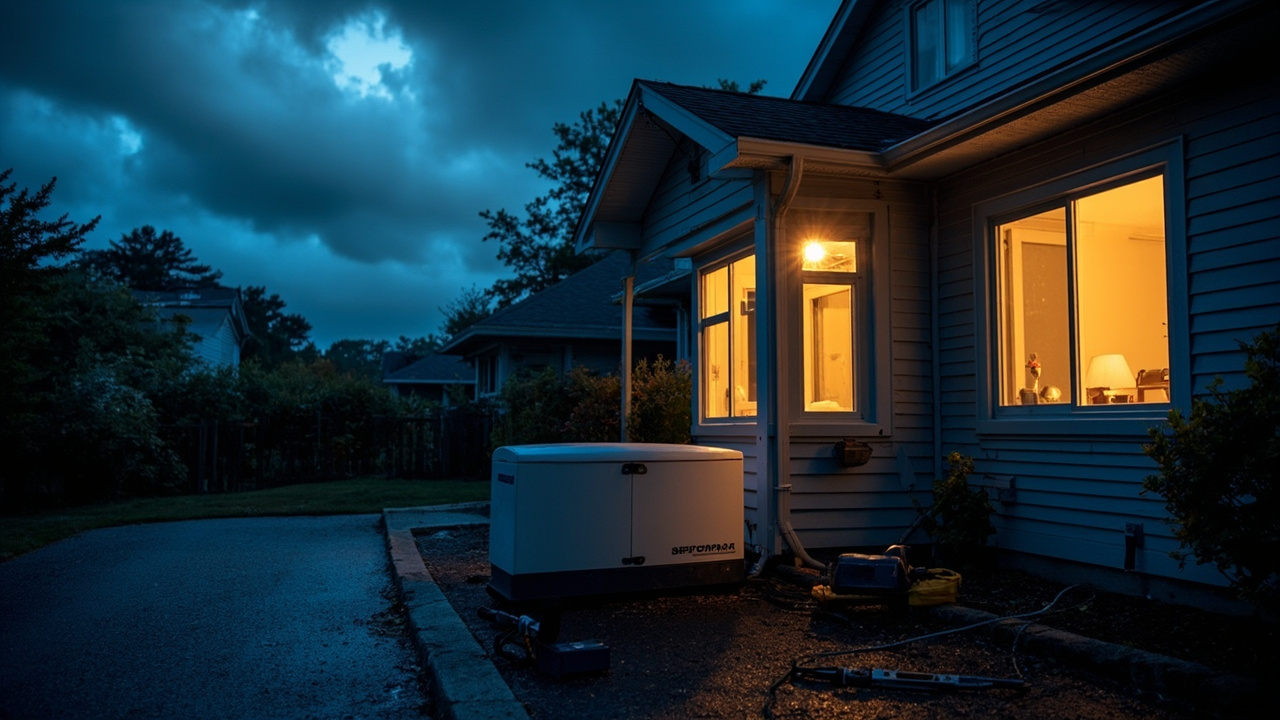
TL;DR: A home generator helps only when your family has listed essential loads, matched them to what the unit can safely support, and arranged safe connection, fuel, maintenance and testing before an outage.
A generator can supply important backup power when utility service fails, but ownership alone does not make a household prepared. According to the GenServe guide titled GenServe | Home Generator Preparedness: Know What Your Family Needs to Keep Powered, families should understand before severe weather or an unexpected outage what must stay powered, what the generator can support and how backup power will be used safely. The guide presents National Preparedness Month as a practical moment to review a household backup-power plan before it must be put into action.
Choose the loads that must stay on
Not every device needs to operate normally during an extended outage. The GenServe preparedness guide recommends starting by identifying what matters most to your household and using those priorities to develop a more effective backup-power plan.
The guide lists examples that different families may treat as essentials:
- Refrigerators and freezers
- Essential lighting
- Phones and communication devices
- Internet equipment
- Medical or other power-dependent equipment
- Well pumps
- Sump pumps
- Heating or cooling equipment, where appropriate
Priorities vary by household. A family that relies on medical equipment, for example, may have very different priorities than another household, according to the same GenServe preparedness guide. Writing those choices down before an outage helps prevent improvised decisions after the lights go out.
Households that depend on electricity for medical needs require additional planning. General federal preparedness resources advise arranging alternative power for electricity-dependent devices and obtaining medication-specific guidance from a medical provider. Keep a written list of each device, its power need and its backup option with emergency contacts.
Match essential loads to generator capability
Once essentials are listed, the next step is understanding the capabilities of the generator. Generators have limits, and attempting to power more equipment than a generator is designed to support can overload the system, according to the GenServe preparedness guide.
Create a list of equipment expected to be used during an outage and understand its power requirements. The generator should be appropriately sized for the loads it is intended to support. Families uncertain what their system can safely power should consult a qualified generator or electrical professional rather than waiting until an outage to find out.
Sizing begins with the electrical loads intended to be available at the same time, not with floor area alone. According to the Home Power Helper guide titled What Size Generator Do I Need for My House?, the right generator size is based on the loads wanted during an outage, with square footage useful only as a screening input because similarly sized houses can have very different backup loads.
That sizing guide explains that generator size is usually discussed in kilowatts, with one kilowatt equal to 1,000 watts. Running load is the power selected equipment uses after it is operating. Starting demand is the brief additional power some motors and compressors need when they start. Refrigerators, well pumps, sump pumps, furnace blowers, air conditioners and heat pumps are common examples where startup behavior matters.
For rough planning, the Home Power Helper sizing guide describes a manufacturer worksheet method that adds simultaneous running watts to the largest additional starting watts to estimate rough peak wattage. That formula offers a first-pass estimate, not a final answer. Motor-starting performance depends on the actual equipment and generator, and professional sizing may need to consider voltage dip, load sequencing and load management.
The same sizing guide cautions that a homeowner worksheet is useful for planning and quote comparisons but is not a substitute for the final load calculation, equipment selection or code-compliant design. Final sizing should be verified against actual equipment labels, the generator output on the chosen fuel, the transfer and load-management design, and the requirements that apply to the installation.
Several categories of equipment most often change a standby calculation. The Home Power Helper sizing guide identifies central air conditioning and heat pumps, electric resistance heat or auxiliary heat strips, well pumps, sump pumps, sewage or grinder pumps, electric water heaters, ranges, ovens, clothes dryers, pool pumps, spas, workshops, detached buildings and Level 2 electric-vehicle charging. Fuel type can also matter because some standby generators have different continuous-output ratings on natural gas and propane.
Know how backup power connects safely
How backup power reaches a home electrical system matters. A permanently installed standby generator typically uses properly installed transfer equipment to separate the home from utility power when the generator is operating, according to the GenServe preparedness guide.
Portable generators require a different precaution. Never attempt to power a home electrical system by plugging the generator into a wall outlet. The GenServe preparedness guide describes that practice as backfeeding and warns that it can create extremely dangerous electrical conditions.
Families that plan to connect a generator to the home electrical system should work with a qualified electrician to ensure appropriate transfer equipment is installed in accordance with applicable requirements. The Home Power Helper sizing guide similarly states that transfer equipment keeps the utility source and generator source from being connected to the home at the same time.
The term whole-house can mislead shoppers. Another Home Power Helper resource, titled Whole-House Generators: Homeowner's Guide, explains that whole-house does not automatically mean every circuit and appliance can run at the same time. Some systems connect a large portion of the home but use load management to temporarily defer high-demand equipment, while others intentionally back up only selected circuits.
Load management can deliberately delay or shed selected loads. The sizing guide notes that whole-home backup does not always mean every large electrical load can run simultaneously. Current residential standby product lines include models from roughly 10 kW through the mid-20s kW and beyond, but that market range is not a sizing rule, according to the same source.
Plan fuel for an extended outage
Backup power planning also requires thinking about duration. The GenServe preparedness guide advises households to consider what would be needed if an outage lasted several hours or longer, rather than preparing only for the first few minutes without power.
For portable generators, families should consider fuel requirements and how fuel will be stored safely and in accordance with manufacturer instructions and local requirements. For permanently installed generators, households should understand the fuel source and how an extended outage could affect expected runtime.
Fuel choice affects output, runtime and installation scope. The Home Power Helper sizing guide states that the same model name or enclosure size does not always mean the same usable kilowatts on both fuels, so shoppers should use the rating for the exact model and fuel they plan to use. A 2,000-square-foot home with gas heat, gas water heating, one air conditioner and city water can present a very different backup load from a similar-size all-electric home with a heat pump, auxiliary heat, a well pump, electric cooking and an electric-vehicle charger.
Store only approved fuels in approved containers, follow manufacturer guidance, and observe local rules. Refuel only as the manufacturer directs, with attention to safe handling and storage.
Maintain and test before severe weather
A generator that sits unused for much of the year still needs attention. The GenServe preparedness guide recommends reviewing the manufacturer recommended maintenance schedule and making sure service is current before severe weather arrives.
Depending on equipment, maintenance may include inspecting or servicing batteries, oil and fluids, filters, electrical components, fuel systems and transfer equipment. GenServe notes that its commercial preventative maintenance programs similarly emphasize proactive inspections, operational testing, batteries, fluids, filters and electrical components because backup-power reliability depends on the maintenance behind the equipment. For a home generator, always follow the specific manufacturer maintenance requirements for that equipment.
Do not make an actual emergency the first operation check. For permanently installed systems, understand how the generator is exercised and tested according to manufacturer guidance. For portable equipment, make sure the people who may need to use it understand the manufacturer operating and safety instructions.
Keep manuals and important service information where they can be found quickly. The GenServe preparedness guide warns that households do not want to start searching for instructions when the lights are already out. Knowing where documentation is stored saves time and reduces unsafe guesswork during an outage.
Make backup power part of the family emergency plan
A backup-power strategy should fit within a larger emergency plan. The National Weather Service recommends knowing the hazards that could affect an area and having reliable ways to receive emergency information, as summarized in the GenServe preparedness guide.
Before an emergency, the guide outlines four knowledge areas. Know your risks by understanding the severe weather and other hazards that could affect the community. Know your power priorities by identifying what the household needs to keep operating. Know your equipment by understanding what the generator can support and how to use it safely. Know your plan by making sure appropriate family members know what to do when power goes out.
Broader household emergency-planning guidance is available through Ready.gov National Preparedness Month resources and federal disaster-preparedness materials referenced in the GenServe preparedness guide. A generator can be an important part of household preparedness, but the generator itself is not the entire plan, according to that guide. Knowing what the family needs to power, maintaining the equipment and understanding how backup power will be used can help households be better prepared when an outage occurs.
Sources referenced
- What Size Generator Do I Need for My House? | Home Power Helper (https://www.homepowerhelper.com/whole-house-generators/what-size-generator/)